A Trillion-Dollar Project Pipeline: What TD's Infrastructure Tally Means for Portfolio Allocation
TD Economics has quantified what people in the construction and engineering sectors have been watching for years: Canadian capital projects now total over $1 trillion in planned value through 2035. The figure comes from the bank's 2024-2025 assessment and includes energy transition builds like battery plants in Ontario and Quebec, carbon capture projects in Alberta, and transmission line expansions from Manitoba to the Maritimes, plus transportation upgrades, power grid modernization, and social infrastructure driven by immigration pressure. A number that large changes the conversation for portfolio managers who have been treating these projects as a niche sleeve.
Why the pipeline exists at all
Two forces created this backlog. The first is decarbonization. Meeting net-zero targets by 2050 requires $25 billion annually just for the electricity grid, according to industry estimates published in 2024 and 2025. That includes battery plants in Ontario and Quebec, carbon capture projects in Alberta, and transmission line expansions from Manitoba to the Maritimes. The second is population growth. Canada added over a million residents in 2024 alone, which stresses transit, hospitals, water systems, and housing-related utilities faster than public budgets can expand them.
This is the setup for what economists call an "approvals gap." The Business Council of Canada and others have documented that the time between a project's announcement and its final investment decision often stretches five to eight years. Environmental reviews, Indigenous consultation frameworks, and fragmented provincial permitting all add layers. The trillion-dollar figure counts announced projects. How many reach completion is a separate question.
The yield question for long-term capital
Mature Canadian assets like toll highways and power grids have historically delivered 4% to 7% annualized returns, according to pension fund disclosures. That range makes them competitive with bonds in a normalized-rate environment but with inflation hedging built in, since many revenues are indexed or tied to usage that rises with population. Private equity and institutional investors have been circling this space since 2023, when public debt levels made it clear governments would need private capital to close the funding gap.
Here is where the structure matters. A toll highway in operation is stable cash flow, low volatility, bond-like. A lithium mine in feasibility stage is equity risk with commodity exposure. A hospital built under a Public-Private Partnership has government payment certainty but construction risk upfront. Advisors treating these projects as one position are collapsing distinctions that change the return profile entirely.
The retail-accessible version of this trade is mutual funds and ETFs focused on these assets, which can sit inside a TFSA at the $7,000 annual limit for 2026. The catch is fee drag. The average Canadian mutual fund carries an MER above 2%, per MoneySense data from July 2026, which compresses net yield on a 5% gross return to 3% or less. ETFs tracking global project indices often include U.S. and European assets, diluting the Canada-specific exposure this pipeline represents.
The execution gap nobody prices in
Canada has capital and it has plans. What it lacks is labor. The skilled trades shortage has been flagged by RBC Economics and others as the binding constraint on this trillion-dollar pipeline. You can approve a subway extension in Toronto, but if there are not enough electricians, pipefitters, and crane operators to build it, the project delays or the cost balloons. Trans Mountain and Coastal GasLink both saw significant overruns, and those were in an era when the labor market was looser than it is now.
Concentration risk is the other unpriced factor. A meaningful portion of the $1 trillion sits in a handful of mega-projects. If one $15 billion LNG facility or battery plant gets shelved due to regulatory or financing issues, the pipeline shrinks by more than 1% in a single stroke. That makes the aggregate figure less stable than it appears.
The capital is real. The opportunity is real. Whether the $1 trillion turns into $1 trillion worth of completed assets depends on approvals, labor, and follow-through. Portfolios built around the assumption that all of it materializes are pricing in best case scenarios.

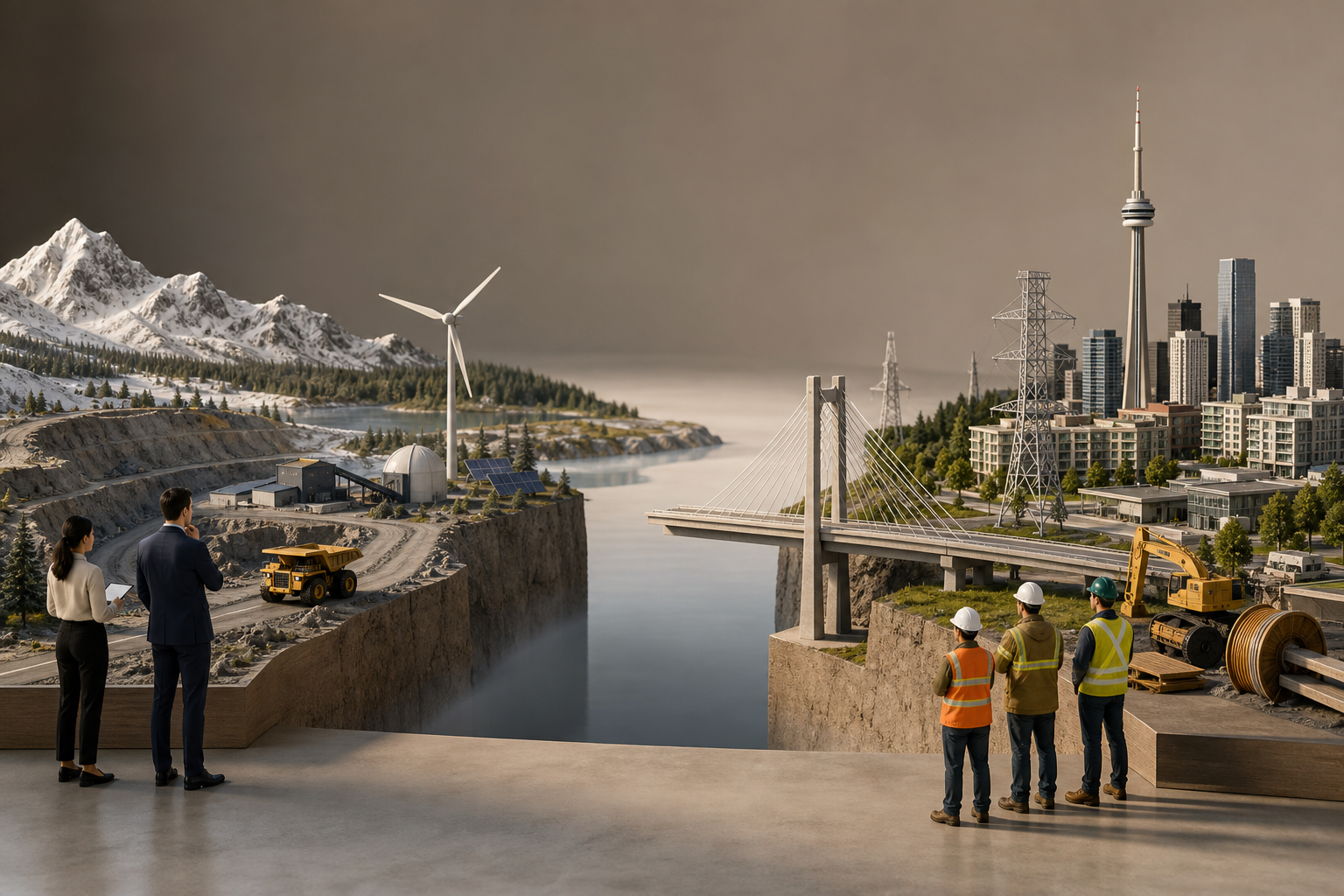

TD Economics has quantified what people in the construction and engineering sectors have been watching for years: Canadian capital projects now total over $1 trillion in planned value through 2035. The figure comes from the bank's 2024-2025 assessment and includes energy transition builds like battery plants in Ontario and Quebec, carbon capture projects in Alberta, and transmission line expansions from Manitoba to the Maritimes, plus transportation upgrades, power grid modernization, and social infrastructure driven by immigration pressure. A number that large changes the conversation for portfolio managers who have been treating these projects as a niche sleeve.
Why the pipeline exists at all
Two forces created this backlog. The first is decarbonization. Meeting net-zero targets by 2050 requires $25 billion annually just for the electricity grid, according to industry estimates published in 2024 and 2025. That includes battery plants in Ontario and Quebec, carbon capture projects in Alberta, and transmission line expansions from Manitoba to the Maritimes. The second is population growth. Canada added over a million residents in 2024 alone, which stresses transit, hospitals, water systems, and housing-related utilities faster than public budgets can expand them.
This is the setup for what economists call an "approvals gap." The Business Council of Canada and others have documented that the time between a project's announcement and its final investment decision often stretches five to eight years. Environmental reviews, Indigenous consultation frameworks, and fragmented provincial permitting all add layers. The trillion-dollar figure counts announced projects. How many reach completion is a separate question.
The yield question for long-term capital
Mature Canadian assets like toll highways and power grids have historically delivered 4% to 7% annualized returns, according to pension fund disclosures. That range makes them competitive with bonds in a normalized-rate environment but with inflation hedging built in, since many revenues are indexed or tied to usage that rises with population. Private equity and institutional investors have been circling this space since 2023, when public debt levels made it clear governments would need private capital to close the funding gap.
Here is where the structure matters. A toll highway in operation is stable cash flow, low volatility, bond-like. A lithium mine in feasibility stage is equity risk with commodity exposure. A hospital built under a Public-Private Partnership has government payment certainty but construction risk upfront. Advisors treating these projects as one position are collapsing distinctions that change the return profile entirely.
The retail-accessible version of this trade is mutual funds and ETFs focused on these assets, which can sit inside a TFSA at the $7,000 annual limit for 2026. The catch is fee drag. The average Canadian mutual fund carries an MER above 2%, per MoneySense data from July 2026, which compresses net yield on a 5% gross return to 3% or less. ETFs tracking global project indices often include U.S. and European assets, diluting the Canada-specific exposure this pipeline represents.
The execution gap nobody prices in
Canada has capital and it has plans. What it lacks is labor. The skilled trades shortage has been flagged by RBC Economics and others as the binding constraint on this trillion-dollar pipeline. You can approve a subway extension in Toronto, but if there are not enough electricians, pipefitters, and crane operators to build it, the project delays or the cost balloons. Trans Mountain and Coastal GasLink both saw significant overruns, and those were in an era when the labor market was looser than it is now.
Concentration risk is the other unpriced factor. A meaningful portion of the $1 trillion sits in a handful of mega-projects. If one $15 billion LNG facility or battery plant gets shelved due to regulatory or financing issues, the pipeline shrinks by more than 1% in a single stroke. That makes the aggregate figure less stable than it appears.
The capital is real. The opportunity is real. Whether the $1 trillion turns into $1 trillion worth of completed assets depends on approvals, labor, and follow-through. Portfolios built around the assumption that all of it materializes are pricing in best case scenarios.
Read Next
Asset managers cut product portfolios to fund AI and outsourcing overhauls
ETFs now hold 42% of Canadian fund assets as OSC tightens crypto and liquidity rules
One in Five Canadian Parents Still Pays Bills for Kids in Their Late Thirties
Joint mortgages surge in Ontario and B.C. as first-time buyers face rising delinquency pressure