Australia Bans AI Music From Official Charts After 16-Week Madonna Knockoff Exposes the Loophole
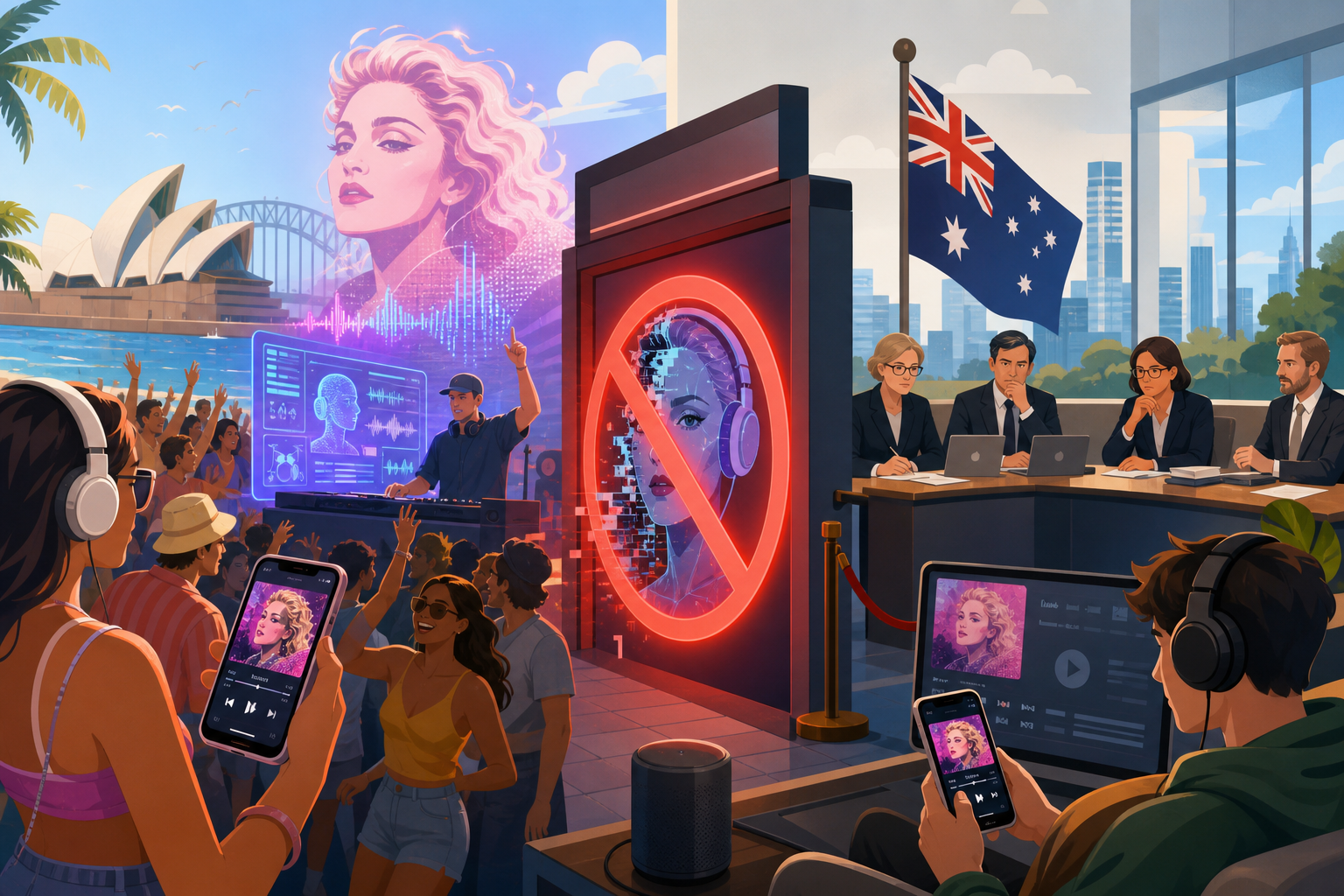
The 16 consecutive weeks should have been impossible. A techno remix of a 1989 hit, credited to producer Loods, climbed into the Australian top 20 and sat there through the entire summer of 2025, racking up streams on what most listeners assumed was a cleared sample. It wasn't. The vocal stems didn't exist in any authorized archive. Loods had used retrieval-based voice conversion software to recreate Madonna's performance on "Like a Prayer" from scratch, training the model on decades of her recorded output. The drums came from a separate generative tool. The official recording never touched the session.
That run ended this month when the Australian Recording Industry Association updated its Chart Eligibility Criteria to exclude tracks "primarily created using generative AI." The new rule specifically targets what ARIA calls "deepfake or AI-cloned vocals" that replicate an existing artist's voice without authorization or direct participation. If a substantial human performance isn't on the track, it doesn't chart.
Why the industry moved now
The Loods case made the existing gap obvious. Australian copyright law, overseen by the Australian Copyright Council, requires a "human author" for a work to receive protection. But ARIA's chart rules said nothing about how a recording had to be made. A producer could train a model on an artist's catalog, generate a convincing vocal, wrap it in a serviceable production, and if the streams hit the threshold, the track charted. The remix proved there was no technical barrier left. RVC tools that once required forum expertise now ship with interfaces a bedroom producer can run in an afternoon.
The 16-week streak wasn't a fluke. The track worked on dancefloors. Listeners who knew it was AI-generated kept streaming it. The ones who didn't know couldn't tell. ARIA's move is an acknowledgment that consumer demand and technical legitimacy have split. A track can function as music, attract an audience, and generate revenue without involving the artist it's mimicking at any stage of production.
What the ban actually covers
ARIA's updated policy draws a line between "AI-assisted" tools and "generative AI." Mixing software that uses machine learning for noise reduction still qualifies as human performance. Synthesizers that rely on neural networks for timbre generation still count. The ban is narrower than it sounds. It applies when the AI replaces the core performance rather than augmenting it.
The rule aligns Australia with the Human Artistry Campaign, an international coalition pushing for copyright protections against unauthorized AI training. The Recording Academy in the U.S. and the RIAA have issued similar statements, though neither has formalized a chart ban yet. ARIA is moving first, partly because the Loods precedent landed in its jurisdiction, and partly because the Australian market is small enough to enforce a clear standard without fragmenting reporting.
The enforcement problem nobody's solved
The policy assumes ARIA can distinguish between a processed human vocal and a high-quality clone. That assumption gets shakier every quarter. Pitch correction already moves a performance away from what the singer actually did in the booth. Melodyne can restructure phrasing. A vocal run through enough plugins starts to resemble what a generative model outputs when the prompt is detailed enough.
ARIA's rule includes an exception for authorized use. If Madonna's estate licenses her voice for a new track, that track can chart. The issue is the licensing and the royalty split. A record label needs to collect money when someone uses a recorded performance, and the estate needs to approve who gets to copy a voice it owns.
A chart position is symbolic. It's also economic. A top-20 run means playlist placement, sync opportunities, and leverage in licensing negotiations. ARIA can ban a track from the chart, but it can't stop Spotify from hosting it or listeners from streaming it. The Loods remix is still live. It just won't show up in next week's official ranking.
That's the actual line being drawn. Not between human and machine. Between what counts and what doesn't.


The 16 consecutive weeks should have been impossible. A techno remix of a 1989 hit, credited to producer Loods, climbed into the Australian top 20 and sat there through the entire summer of 2025, racking up streams on what most listeners assumed was a cleared sample. It wasn't. The vocal stems didn't exist in any authorized archive. Loods had used retrieval-based voice conversion software to recreate Madonna's performance on "Like a Prayer" from scratch, training the model on decades of her recorded output. The drums came from a separate generative tool. The official recording never touched the session.
That run ended this month when the Australian Recording Industry Association updated its Chart Eligibility Criteria to exclude tracks "primarily created using generative AI." The new rule specifically targets what ARIA calls "deepfake or AI-cloned vocals" that replicate an existing artist's voice without authorization or direct participation. If a substantial human performance isn't on the track, it doesn't chart.
Why the industry moved now
The Loods case made the existing gap obvious. Australian copyright law, overseen by the Australian Copyright Council, requires a "human author" for a work to receive protection. But ARIA's chart rules said nothing about how a recording had to be made. A producer could train a model on an artist's catalog, generate a convincing vocal, wrap it in a serviceable production, and if the streams hit the threshold, the track charted. The remix proved there was no technical barrier left. RVC tools that once required forum expertise now ship with interfaces a bedroom producer can run in an afternoon.
The 16-week streak wasn't a fluke. The track worked on dancefloors. Listeners who knew it was AI-generated kept streaming it. The ones who didn't know couldn't tell. ARIA's move is an acknowledgment that consumer demand and technical legitimacy have split. A track can function as music, attract an audience, and generate revenue without involving the artist it's mimicking at any stage of production.
What the ban actually covers
ARIA's updated policy draws a line between "AI-assisted" tools and "generative AI." Mixing software that uses machine learning for noise reduction still qualifies as human performance. Synthesizers that rely on neural networks for timbre generation still count. The ban is narrower than it sounds. It applies when the AI replaces the core performance rather than augmenting it.
The rule aligns Australia with the Human Artistry Campaign, an international coalition pushing for copyright protections against unauthorized AI training. The Recording Academy in the U.S. and the RIAA have issued similar statements, though neither has formalized a chart ban yet. ARIA is moving first, partly because the Loods precedent landed in its jurisdiction, and partly because the Australian market is small enough to enforce a clear standard without fragmenting reporting.
The enforcement problem nobody's solved
The policy assumes ARIA can distinguish between a processed human vocal and a high-quality clone. That assumption gets shakier every quarter. Pitch correction already moves a performance away from what the singer actually did in the booth. Melodyne can restructure phrasing. A vocal run through enough plugins starts to resemble what a generative model outputs when the prompt is detailed enough.
ARIA's rule includes an exception for authorized use. If Madonna's estate licenses her voice for a new track, that track can chart. The issue is the licensing and the royalty split. A record label needs to collect money when someone uses a recorded performance, and the estate needs to approve who gets to copy a voice it owns.
A chart position is symbolic. It's also economic. A top-20 run means playlist placement, sync opportunities, and leverage in licensing negotiations. ARIA can ban a track from the chart, but it can't stop Spotify from hosting it or listeners from streaming it. The Loods remix is still live. It just won't show up in next week's official ranking.
That's the actual line being drawn. Not between human and machine. Between what counts and what doesn't.
Read Next
Asset managers cut product portfolios to fund AI and outsourcing overhauls
ETFs now hold 42% of Canadian fund assets as OSC tightens crypto and liquidity rules
One in Five Canadian Parents Still Pays Bills for Kids in Their Late Thirties
Joint mortgages surge in Ontario and B.C. as first-time buyers face rising delinquency pressure