Canada's $2.68 Trillion Debt Load Masks a Harder Problem: Non-Mortgage Borrowing Is Climbing Fast
The Equifax Canada report released last month shows mortgage holders missing payments on their credit cards and lines of credit at rates not seen since 2020. These borrowers are current with their housing payments on paper, but carrying delinquencies elsewhere on their credit files. The $2.68 trillion figure that dominated headlines in July tells you how much Canadians owe. It does not tell you where the system is bending.
Non-mortgage debt is now the primary engine of growth in household leverage. Credit card balances have climbed year-over-year in the current high-inflation environment, and revolving credit is no longer a convenience tool. It is a bridge. Families are using Visa and Mastercard to cover groceries, utilities, and childcare, expenses that were previously paid from cashflow. The debt is being added at the point where income has already been spoken for.
Why mortgage holders are defaulting everywhere except their mortgage
The behaviour showing up in delinquency data is structurally rational. A homeowner who took out a five-year fixed mortgage in 2021 at 1.79% is renewing in 2026 at something closer to 4.5%. That difference, on a $400,000 mortgage with 23 years remaining, is roughly $650 more per month. This payment increase arrives every month whether or not the household budget can accommodate it.
When discretionary income disappears, the hierarchy of payments becomes visible. The mortgage gets paid first. The consequence of missing it, losing the home, is immediate and irreversible. The consequence of missing a credit card payment is a phone call, a fee, and a mark on the credit file. The system has built in an implicit ranking, and consumers are following it. They are protecting the asset and defaulting on everything else.
This is why 90-day delinquency rates for non-mortgage products are climbing while mortgage arrears remain relatively contained. The stress is concentrated in the portion of the balance sheet that does not carry collateral.
The income problem that debt hides
Total household debt figures are often softened by pointing to Canada's high household net worth, most of which is locked in real estate. A family with $1.2 million in home equity and $85,000 in credit card and auto loan debt is technically solvent. They are also, in many cases, illiquid. Home equity cannot be spent on groceries without refinancing or selling. Refinancing into a higher rate to clear credit cards works only if the rate on the new mortgage is lower than the blended rate on the cards, and in 2026 it usually is not.
The $2.68 trillion total is also being driven upward by population growth. Record immigration levels in 2025 and early 2026 added hundreds of thousands of new credit files to the system. More people means more total debt, and per-capita borrowing has climbed as well. The composition reveals fragility more clearly than size alone.
Canadian banks increased their loan-loss provisions in the first half of 2026, signalling that defaults are expected to rise further before they stabilize. These provisions are being set for unsecured consumer credit, where recovery rates are low and losses are taken in full, not for mortgage writedowns.
The headline number will keep climbing as long as population grows and home prices stay elevated. The danger lies in the segment of the total that households are servicing with cashflow they do not have, in categories where default has no deterrent except damage to a score that has already started falling.

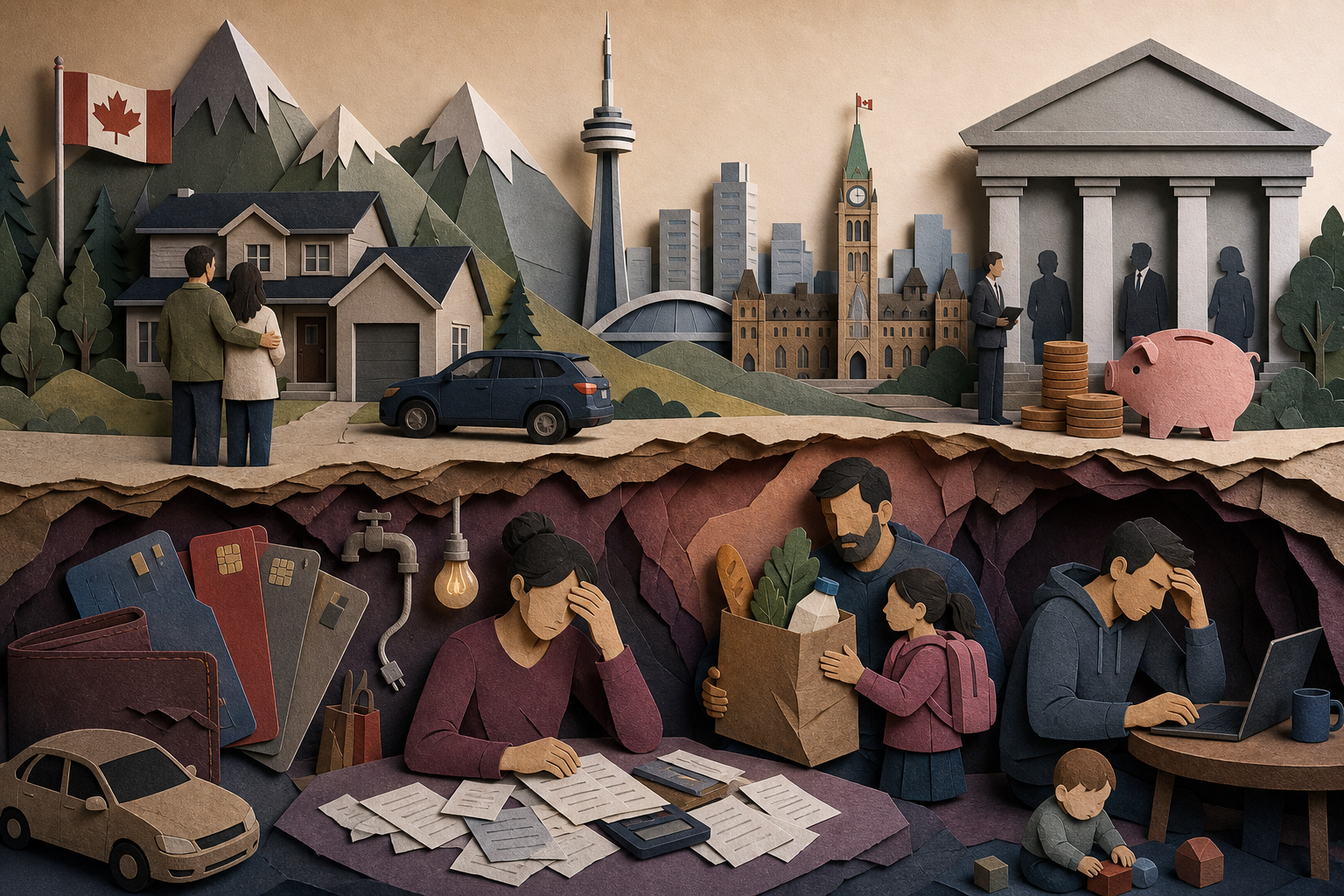

The Equifax Canada report released last month shows mortgage holders missing payments on their credit cards and lines of credit at rates not seen since 2020. These borrowers are current with their housing payments on paper, but carrying delinquencies elsewhere on their credit files. The $2.68 trillion figure that dominated headlines in July tells you how much Canadians owe. It does not tell you where the system is bending.
Non-mortgage debt is now the primary engine of growth in household leverage. Credit card balances have climbed year-over-year in the current high-inflation environment, and revolving credit is no longer a convenience tool. It is a bridge. Families are using Visa and Mastercard to cover groceries, utilities, and childcare, expenses that were previously paid from cashflow. The debt is being added at the point where income has already been spoken for.
Why mortgage holders are defaulting everywhere except their mortgage
The behaviour showing up in delinquency data is structurally rational. A homeowner who took out a five-year fixed mortgage in 2021 at 1.79% is renewing in 2026 at something closer to 4.5%. That difference, on a $400,000 mortgage with 23 years remaining, is roughly $650 more per month. This payment increase arrives every month whether or not the household budget can accommodate it.
When discretionary income disappears, the hierarchy of payments becomes visible. The mortgage gets paid first. The consequence of missing it, losing the home, is immediate and irreversible. The consequence of missing a credit card payment is a phone call, a fee, and a mark on the credit file. The system has built in an implicit ranking, and consumers are following it. They are protecting the asset and defaulting on everything else.
This is why 90-day delinquency rates for non-mortgage products are climbing while mortgage arrears remain relatively contained. The stress is concentrated in the portion of the balance sheet that does not carry collateral.
The income problem that debt hides
Total household debt figures are often softened by pointing to Canada's high household net worth, most of which is locked in real estate. A family with $1.2 million in home equity and $85,000 in credit card and auto loan debt is technically solvent. They are also, in many cases, illiquid. Home equity cannot be spent on groceries without refinancing or selling. Refinancing into a higher rate to clear credit cards works only if the rate on the new mortgage is lower than the blended rate on the cards, and in 2026 it usually is not.
The $2.68 trillion total is also being driven upward by population growth. Record immigration levels in 2025 and early 2026 added hundreds of thousands of new credit files to the system. More people means more total debt, and per-capita borrowing has climbed as well. The composition reveals fragility more clearly than size alone.
Canadian banks increased their loan-loss provisions in the first half of 2026, signalling that defaults are expected to rise further before they stabilize. These provisions are being set for unsecured consumer credit, where recovery rates are low and losses are taken in full, not for mortgage writedowns.
The headline number will keep climbing as long as population grows and home prices stay elevated. The danger lies in the segment of the total that households are servicing with cashflow they do not have, in categories where default has no deterrent except damage to a score that has already started falling.
Sources
Read Next
Asset managers cut product portfolios to fund AI and outsourcing overhauls
ETFs now hold 42% of Canadian fund assets as OSC tightens crypto and liquidity rules
One in Five Canadian Parents Still Pays Bills for Kids in Their Late Thirties
Joint mortgages surge in Ontario and B.C. as first-time buyers face rising delinquency pressure