Canada's 2036 housing target stays at 4.69 million homes, another decade of the same shortage
The federal government last year pushed its housing shortage estimate out another decade. The 4.69 million figure, originally tied to 2030, now applies to 2036. CMHC reframed the target as a longer-term aspiration. Nothing else changed. The arithmetic stayed put. Canada still needs 4.69 million new homes to restore affordability to where the average household spends no more than 30% of income on shelter. The timeline just got ten more years.
For investors and homeowners, that shift does two things. It confirms demand will outrun supply for at least another generation. And it admits the policy apparatus, zoning reforms, transit-oriented mandates, accelerator funds, has failed to close the gap at the speed originally promised.
The target is real but the timeline keeps sliding
CMHC introduced the 3.5 million figure in 2022 as the number of additional units Canada needed by 2030 to bring prices and rents back to a sustainable ratio relative to incomes. By 2026, with starts lagging and approvals caught in delays for sewer, water, and electrical upgrades, the agency quietly extended the horizon to 2036. The shortage estimate held. The deadline moved.
Vancouver officially surpassed its 2025 housing targets by April 2026, according to city data, but "surpassed" meant approved units, not completed ones. The City of Vancouver's progress report shows strong approval volumes. What it doesn't show is how many of those approvals cleared construction and became move-in-ready homes. In a high-cost market with labour shortages and rising Development Cost Charges, the lag between permit and occupancy can stretch three years.
British Columbia's transit-oriented development mandates require high-density zoning within 800 metres of SkyTrain stations and 400 metres of major bus exchanges. Alberta's Bill 18 streamlined secondary suites and backyard units in Calgary and Edmonton. The federal Housing Accelerator Fund tied billions to municipal elimination of exclusionary zoning, pushing fourplexes as a right across residential zones. All of that matters. None of it moved fast enough to meet the original 2030 timeline.
What a supply gap this large actually does
A persistent gap between needed supply and actual construction does not flatten prices. It props them up. If Canada were on pace to deliver 4.69 million units by 2036, prices in Victoria and Vancouver would already be adjusting downward in anticipation. They aren't. Benchmark prices for Vancouver West detached homes sit between $1.78 million and $1.82 million as of mid-2026, down modestly from the 2022 peak but nowhere near the correction a real supply surge would trigger.
For investors, this means rental demand stays structural, not cyclical. A decade-plus shortage guarantees tenant demand in urban transit corridors, and it keeps upward pressure on rents even when interest rates climb. The risk isn't vacancy. The risk is municipality-by-municipality delays that strand capital in projects that take four years to deliver instead of two.
Grid upgrades nobody prices in
Increasing density to meet the 4.69 million target stresses aging sewer, water, and electrical grids. Municipalities respond by raising Development Cost Charges. In British Columbia, DCCs on a new townhouse project can exceed $30,000 per unit in some Metro Vancouver suburbs. Those costs get passed to buyers, which flattens the affordability gain the new supply was supposed to create.
Victoria's Missing Middle Housing Policy allows conversion of single-family lots into multi-unit buildings without traditional rezoning, provided the design meets guidelines. That policy speeds approvals. It does not speed grid upgrades. A fourplex on a lot zoned for one house draws four times the water and power. If the pipes and wires can't handle it, the municipality delays the permit or forces the developer to fund the upgrade. Either way, the unit cost climbs.
The 2036 target assumes sewer, water, and electrical capacity keep pace with approvals. It rarely does.
What this means for the next property you buy
In a normal market, a credible plan to flood supply would soften prices and widen the window for buyers. In this market, the plan exists but the flood doesn't. The 4.69 million figure tells you demand is locked in for another decade at least. If you are buying near transit in Victoria, within 800 metres of a SkyTrain station in Metro Vancouver, or near a bus exchange with high-density zoning, you are buying into regulatory protection that limits downside risk. The as-of-right density on those lots is worth more than the structure sitting on them.
The target won't be met by 2036. The number is useful anyway. It measures the floor under the market, not the ceiling.

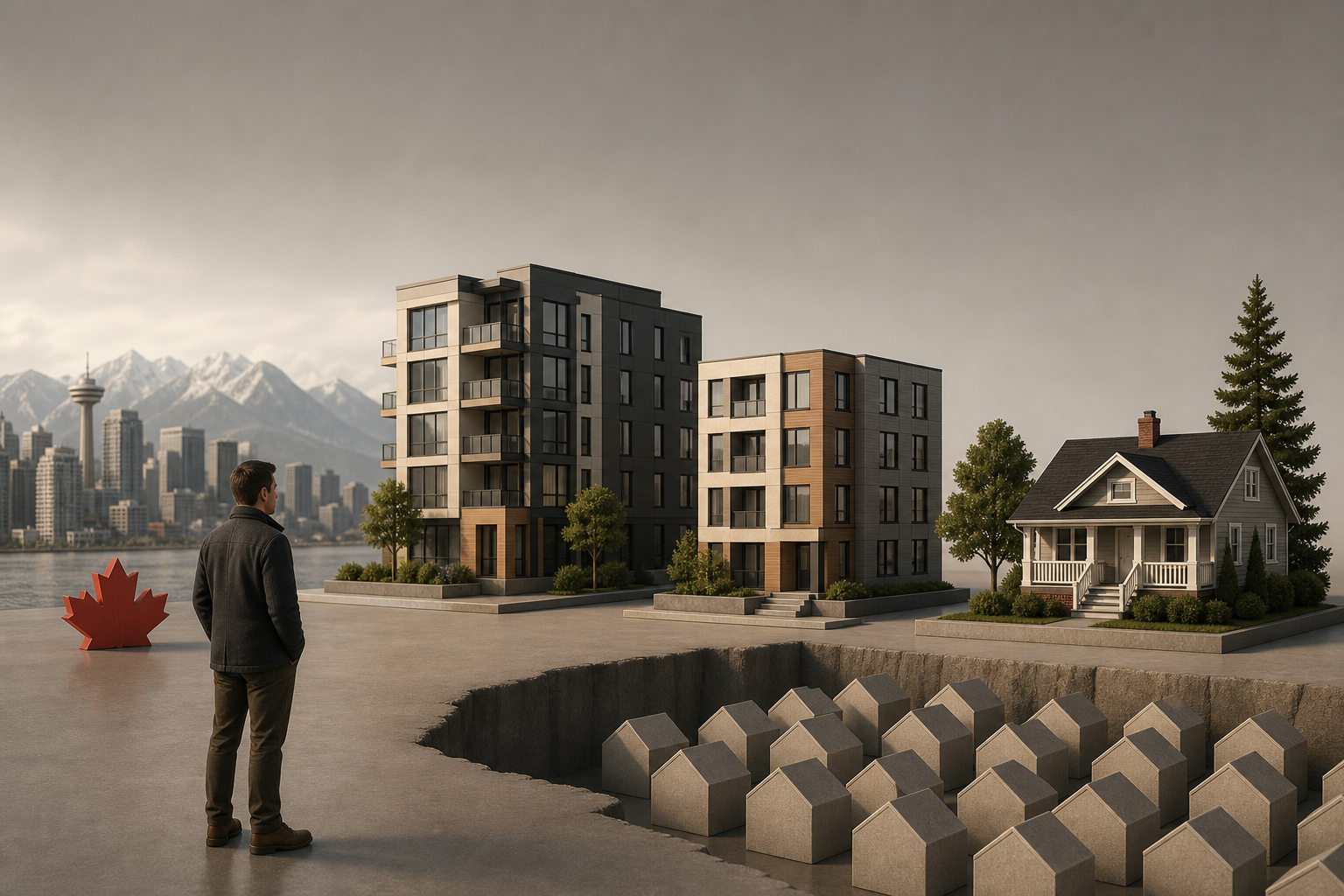

The federal government last year pushed its housing shortage estimate out another decade. The 4.69 million figure, originally tied to 2030, now applies to 2036. CMHC reframed the target as a longer-term aspiration. Nothing else changed. The arithmetic stayed put. Canada still needs 4.69 million new homes to restore affordability to where the average household spends no more than 30% of income on shelter. The timeline just got ten more years.
For investors and homeowners, that shift does two things. It confirms demand will outrun supply for at least another generation. And it admits the policy apparatus, zoning reforms, transit-oriented mandates, accelerator funds, has failed to close the gap at the speed originally promised.
The target is real but the timeline keeps sliding
CMHC introduced the 3.5 million figure in 2022 as the number of additional units Canada needed by 2030 to bring prices and rents back to a sustainable ratio relative to incomes. By 2026, with starts lagging and approvals caught in delays for sewer, water, and electrical upgrades, the agency quietly extended the horizon to 2036. The shortage estimate held. The deadline moved.
Vancouver officially surpassed its 2025 housing targets by April 2026, according to city data, but "surpassed" meant approved units, not completed ones. The City of Vancouver's progress report shows strong approval volumes. What it doesn't show is how many of those approvals cleared construction and became move-in-ready homes. In a high-cost market with labour shortages and rising Development Cost Charges, the lag between permit and occupancy can stretch three years.
British Columbia's transit-oriented development mandates require high-density zoning within 800 metres of SkyTrain stations and 400 metres of major bus exchanges. Alberta's Bill 18 streamlined secondary suites and backyard units in Calgary and Edmonton. The federal Housing Accelerator Fund tied billions to municipal elimination of exclusionary zoning, pushing fourplexes as a right across residential zones. All of that matters. None of it moved fast enough to meet the original 2030 timeline.
What a supply gap this large actually does
A persistent gap between needed supply and actual construction does not flatten prices. It props them up. If Canada were on pace to deliver 4.69 million units by 2036, prices in Victoria and Vancouver would already be adjusting downward in anticipation. They aren't. Benchmark prices for Vancouver West detached homes sit between $1.78 million and $1.82 million as of mid-2026, down modestly from the 2022 peak but nowhere near the correction a real supply surge would trigger.
For investors, this means rental demand stays structural, not cyclical. A decade-plus shortage guarantees tenant demand in urban transit corridors, and it keeps upward pressure on rents even when interest rates climb. The risk isn't vacancy. The risk is municipality-by-municipality delays that strand capital in projects that take four years to deliver instead of two.
Grid upgrades nobody prices in
Increasing density to meet the 4.69 million target stresses aging sewer, water, and electrical grids. Municipalities respond by raising Development Cost Charges. In British Columbia, DCCs on a new townhouse project can exceed $30,000 per unit in some Metro Vancouver suburbs. Those costs get passed to buyers, which flattens the affordability gain the new supply was supposed to create.
Victoria's Missing Middle Housing Policy allows conversion of single-family lots into multi-unit buildings without traditional rezoning, provided the design meets guidelines. That policy speeds approvals. It does not speed grid upgrades. A fourplex on a lot zoned for one house draws four times the water and power. If the pipes and wires can't handle it, the municipality delays the permit or forces the developer to fund the upgrade. Either way, the unit cost climbs.
The 2036 target assumes sewer, water, and electrical capacity keep pace with approvals. It rarely does.
What this means for the next property you buy
In a normal market, a credible plan to flood supply would soften prices and widen the window for buyers. In this market, the plan exists but the flood doesn't. The 4.69 million figure tells you demand is locked in for another decade at least. If you are buying near transit in Victoria, within 800 metres of a SkyTrain station in Metro Vancouver, or near a bus exchange with high-density zoning, you are buying into regulatory protection that limits downside risk. The as-of-right density on those lots is worth more than the structure sitting on them.
The target won't be met by 2036. The number is useful anyway. It measures the floor under the market, not the ceiling.
Sources
Read Next
The Expensive Relief of Locking in at the Top
A 4% Mortgage Qualifies at 6%: Reading the Stress Test Correctly in 2026
Economists Forecast Interest Rates as a Herd, and Borrowers Pay for the Misses
Rents Move Last: Read Employer Investment to Spot Demand 18 to 24 Months Early