Canada's Office Market Split: Why CIBC Square Leases Fully While Vacancy Rates Hit Record Highs
Canada's Office Market Split: Why CIBC Square Leases Fully While Vacancy Rates Hit Record Highs
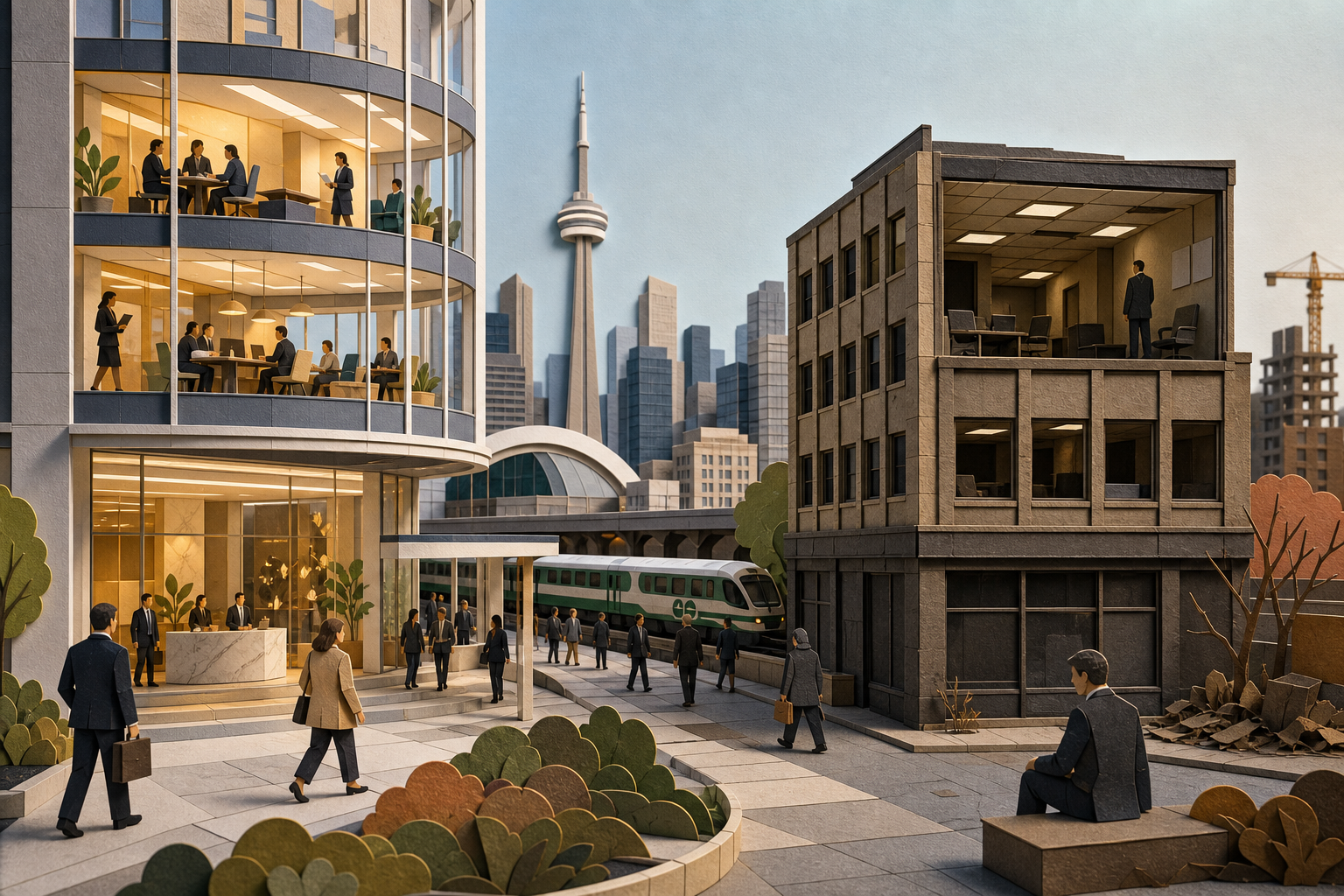
Toronto's CIBC Square sits at 100% occupancy while the national office vacancy rate has fallen to 17.1%. Same city. Same market. Different centuries.
The dividing line is not location. It's vintage and amenity load. CIBC Square, completed in phases between 2021 and 2026, is a LEED Platinum-certified, transit-connected tower with floor plates designed for collaborative workspace and ground-floor retail that reads more like a hotel lobby than a corporate box. The building two blocks over, a 1987-vintage Class B tower with drop ceilings and HVAC you can hear through the walls, is showing 34% availability and falling asking rents.
That gap is the Canadian office market in 2026.
The flight-to-quality thesis, quantified
The aggregate vacancy figure tells you almost nothing useful. Colliers reported the national rate at 13.6% in Q1 2026, while CBRE reported 18.2% for downtown markets nationally. Downtown Toronto sits around 14.4% as of Q1 2026, having improved significantly from a year earlier. But those numbers bundle together buildings that have nothing in common except four walls and a lease structure.
Class AAA assets in Vancouver and Toronto are still commanding net rents north of $50 to $60 per square foot, figures that would have been record-setting five years ago. Meanwhile, secondary office stock built in the 1980s and 1990s is seeing effective rents drop into the low $30s after concessions. The spread between trophy and tertiary has never been wider.
This is not a temporary dislocation. It is a repricing based on corporate mandates that did not exist in 2019. Tenants returning workers to the office three or four days a week are not bringing them back to beige carpet and fluorescent tubes. They are leasing space that doubles as a recruitment tool and satisfies ESG reporting requirements their boards now track quarterly.
CIBC Square checks every box: Net Zero carbon certification, direct PATH connectivity to Union Station, 30,000 square feet of curated ground-floor amenities, outdoor terraces on multiple floors. It is an argument for showing up. A 1988 building with a view of the Gardiner Expressway is not.
Why conversion is not the escape hatch
The obvious response to a glut of aging office inventory is residential conversion. Provincial and federal programs have floated incentives. Calgary has successfully converted several downtown towers into apartments. The economics pencil in narrow cases.
Most of the stranded Class B stock in Toronto and Montreal does not qualify. Floor plates in older office buildings run 20,000 to 30,000 square feet with core depths that make residential unit layouts nearly impossible without gutting the structure to the frame. Plumbing, electrical, and HVAC retrofits for multi-unit residential can exceed the cost of new construction. A 2025 feasibility study commissioned by a Toronto pension fund found that fewer than 12% of the city's pre-1995 office buildings were physically suitable for conversion, and only half of those penciled financially even with government subsidies.
So the buildings sit. Pension funds and REITs, already underwater after the 2022-2024 rate shock crushed valuations, cannot afford to sell at current prices. They cannot afford to retrofit. The alternative is to hold and hope for an impossible rent recovery.
That is the "zombie building" problem, and it is not getting smaller.
What the sublease shadow hides
Altus Group estimates that a significant portion of Canada's office availability is shadow vacancy: space still under lease but offered for sublease by tenants who signed long-term deals pre-pandemic and no longer need the square footage. That inventory does not show up in headline vacancy stats until the lease term ends and the space returns to the landlord.
When those leases roll off between 2027 and 2029, the direct vacancy rate will spike again even if no additional tenants vacate. The current 17% to 18% national figure masks this coming wave.
The market has split into two non-overlapping sets. Premium product in premium locations will lease. Everything else is fighting for a shrinking pool of tenants willing to settle, and that pool gets smaller every lease cycle.
CIBC Square proves the office is not dead. It proves most offices are.


Canada's Office Market Split: Why CIBC Square Leases Fully While Vacancy Rates Hit Record Highs
Toronto's CIBC Square sits at 100% occupancy while the national office vacancy rate has fallen to 17.1%. Same city. Same market. Different centuries.
The dividing line is not location. It's vintage and amenity load. CIBC Square, completed in phases between 2021 and 2026, is a LEED Platinum-certified, transit-connected tower with floor plates designed for collaborative workspace and ground-floor retail that reads more like a hotel lobby than a corporate box. The building two blocks over, a 1987-vintage Class B tower with drop ceilings and HVAC you can hear through the walls, is showing 34% availability and falling asking rents.
That gap is the Canadian office market in 2026.
The flight-to-quality thesis, quantified
The aggregate vacancy figure tells you almost nothing useful. Colliers reported the national rate at 13.6% in Q1 2026, while CBRE reported 18.2% for downtown markets nationally. Downtown Toronto sits around 14.4% as of Q1 2026, having improved significantly from a year earlier. But those numbers bundle together buildings that have nothing in common except four walls and a lease structure.
Class AAA assets in Vancouver and Toronto are still commanding net rents north of $50 to $60 per square foot, figures that would have been record-setting five years ago. Meanwhile, secondary office stock built in the 1980s and 1990s is seeing effective rents drop into the low $30s after concessions. The spread between trophy and tertiary has never been wider.
This is not a temporary dislocation. It is a repricing based on corporate mandates that did not exist in 2019. Tenants returning workers to the office three or four days a week are not bringing them back to beige carpet and fluorescent tubes. They are leasing space that doubles as a recruitment tool and satisfies ESG reporting requirements their boards now track quarterly.
CIBC Square checks every box: Net Zero carbon certification, direct PATH connectivity to Union Station, 30,000 square feet of curated ground-floor amenities, outdoor terraces on multiple floors. It is an argument for showing up. A 1988 building with a view of the Gardiner Expressway is not.
Why conversion is not the escape hatch
The obvious response to a glut of aging office inventory is residential conversion. Provincial and federal programs have floated incentives. Calgary has successfully converted several downtown towers into apartments. The economics pencil in narrow cases.
Most of the stranded Class B stock in Toronto and Montreal does not qualify. Floor plates in older office buildings run 20,000 to 30,000 square feet with core depths that make residential unit layouts nearly impossible without gutting the structure to the frame. Plumbing, electrical, and HVAC retrofits for multi-unit residential can exceed the cost of new construction. A 2025 feasibility study commissioned by a Toronto pension fund found that fewer than 12% of the city's pre-1995 office buildings were physically suitable for conversion, and only half of those penciled financially even with government subsidies.
So the buildings sit. Pension funds and REITs, already underwater after the 2022-2024 rate shock crushed valuations, cannot afford to sell at current prices. They cannot afford to retrofit. The alternative is to hold and hope for an impossible rent recovery.
That is the "zombie building" problem, and it is not getting smaller.
What the sublease shadow hides
Altus Group estimates that a significant portion of Canada's office availability is shadow vacancy: space still under lease but offered for sublease by tenants who signed long-term deals pre-pandemic and no longer need the square footage. That inventory does not show up in headline vacancy stats until the lease term ends and the space returns to the landlord.
When those leases roll off between 2027 and 2029, the direct vacancy rate will spike again even if no additional tenants vacate. The current 17% to 18% national figure masks this coming wave.
The market has split into two non-overlapping sets. Premium product in premium locations will lease. Everything else is fighting for a shrinking pool of tenants willing to settle, and that pool gets smaller every lease cycle.
CIBC Square proves the office is not dead. It proves most offices are.
Sources
Read Next
Asset managers cut product portfolios to fund AI and outsourcing overhauls
ETFs now hold 42% of Canadian fund assets as OSC tightens crypto and liquidity rules
One in Five Canadian Parents Still Pays Bills for Kids in Their Late Thirties
Joint mortgages surge in Ontario and B.C. as first-time buyers face rising delinquency pressure