Canadian small businesses hit triple burden: debt stress, municipal overreach, tariff chaos
A Vancouver café owner refinanced $85,000 in CEBA debt at 7.9% in early 2024. By mid-2026, the monthly payment eats 14% of gross revenue before rent, payroll, or inventory. The café is paying for survival.
Business insolvencies climbed over 40% year-over-year following the CEBA repayment deadline, per the Office of the Superintendent of Bankruptcy. The figure is the back end of a delayed correction. Thousands of firms that borrowed to stay open during lockdowns now service debt in an economy that no longer subsidizes their existence. Interest payments above 10% of revenue, once rare outside distressed cases, have become routine for retailers and hospitality operators across Ontario and BC.
The municipal tax nobody calls a tax
Property tax ratios in Toronto and Vancouver run more than double the residential rate for equivalent assessed value in the 2025-2026 tax year. That is the visible cost. The invisible one is time. A permit that takes six weeks in one municipality can take six months in another, with no difference in the complexity of the application. The delay does not register as a line item. It registers as cash burn while the business waits to open, expand, or pivot.
Cities argue they are constrained by provincial revenue frameworks, which is accurate. It does not change the outcome for the operator trying to convert a closed retail unit into a café under bylaws written for a different decade. The regulatory structure treats every application as high-risk until proven otherwise. Large firms hire consultants to navigate the process. Small firms lose months they cannot afford to lose.
Tariff volatility as a pricing ceiling
U.S. tariffs on certain Canadian imports jumped to 50% effective August 22, 2026, according to the Department of Finance. For manufacturers and distributors with exposure to cross-border supply chains, raising prices risks losing customers to big-box competitors with better purchasing power, while absorbing the cost compresses already thin margins. The tariff does not bankrupt firms directly. It removes the room for error.
Small-scale importers report that tariff uncertainty has a second-order effect on inventory decisions. Ordering forward to lock in lower costs requires cash or credit access. Firms already servicing high debt loads lack both. The result is shorter order cycles, higher per-unit costs, and less ability to absorb demand spikes when they occur.
What insolvency numbers actually mean
The rise in business failures is being framed in some quarters as creative destruction, a market correction that clears out firms kept alive only by emergency subsidies. That framing holds for some cases. It does not hold for profitable firms killed by debt servicing costs that spiked 300 basis points in eighteen months. The Bank of Canada's overnight rate moves have pushed prime-plus lending to levels that turn viable businesses into insolvent ones based solely on refinancing timing.
B2B service firms and specialized tech SMEs show higher resilience to rate fluctuations. Retail, dining, and physical goods distribution do not. A higher portion of revenue must now go to interest before anything else gets paid, determined by how the business was financed and when it refinanced.
The federal government provided direct cash during the pandemic. Provincial governments extended deferrals. Municipal governments continued to rely on commercial property tax as a primary revenue source and did not meaningfully reform zoning or permitting to reflect a changed economy. The asymmetry matters because cities control the friction that determines whether a small business can adapt. Simplifying land-use bylaws would function as stimulus without costing the treasury a dollar. It has not happened.

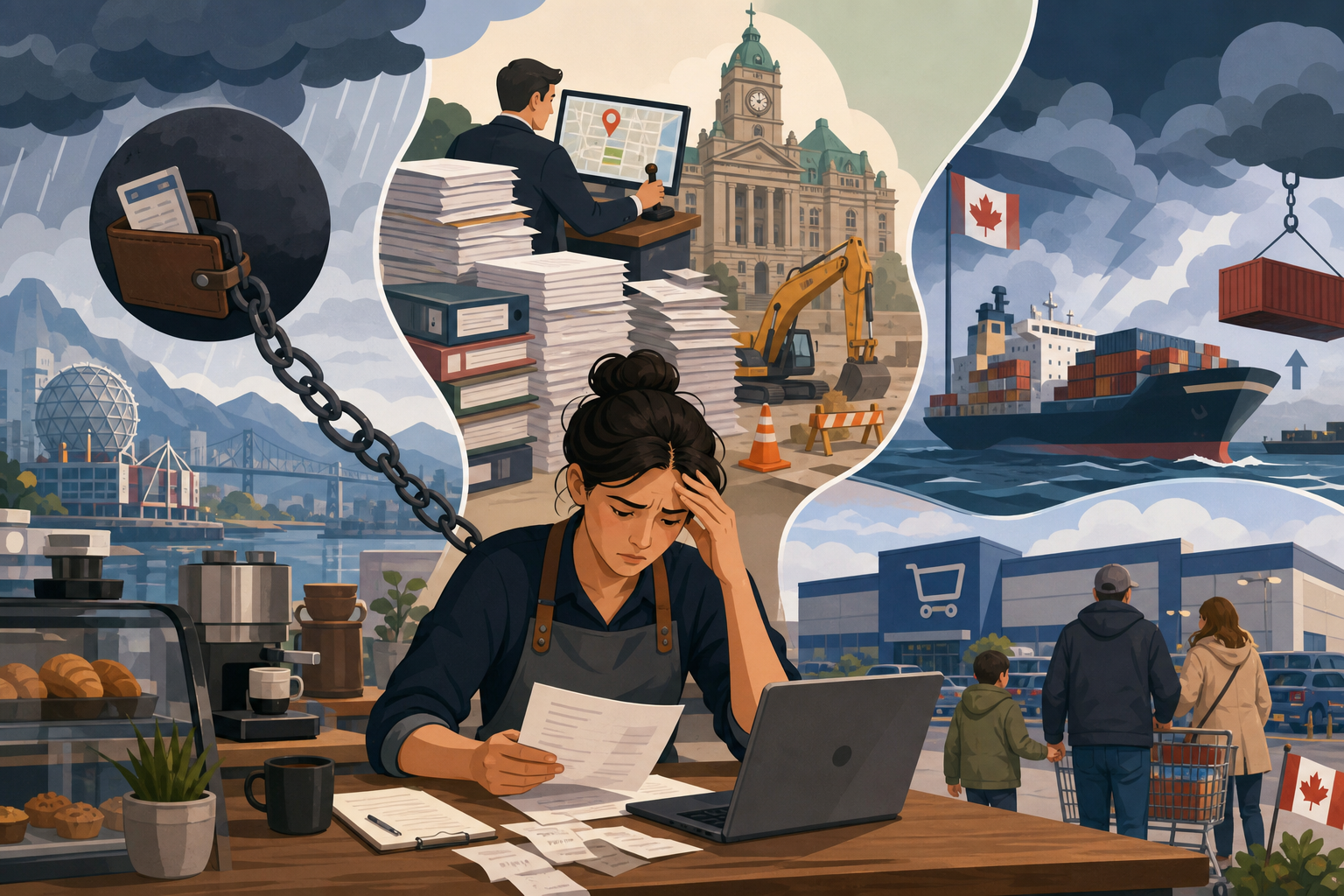

A Vancouver café owner refinanced $85,000 in CEBA debt at 7.9% in early 2024. By mid-2026, the monthly payment eats 14% of gross revenue before rent, payroll, or inventory. The café is paying for survival.
Business insolvencies climbed over 40% year-over-year following the CEBA repayment deadline, per the Office of the Superintendent of Bankruptcy. The figure is the back end of a delayed correction. Thousands of firms that borrowed to stay open during lockdowns now service debt in an economy that no longer subsidizes their existence. Interest payments above 10% of revenue, once rare outside distressed cases, have become routine for retailers and hospitality operators across Ontario and BC.
The municipal tax nobody calls a tax
Property tax ratios in Toronto and Vancouver run more than double the residential rate for equivalent assessed value in the 2025-2026 tax year. That is the visible cost. The invisible one is time. A permit that takes six weeks in one municipality can take six months in another, with no difference in the complexity of the application. The delay does not register as a line item. It registers as cash burn while the business waits to open, expand, or pivot.
Cities argue they are constrained by provincial revenue frameworks, which is accurate. It does not change the outcome for the operator trying to convert a closed retail unit into a café under bylaws written for a different decade. The regulatory structure treats every application as high-risk until proven otherwise. Large firms hire consultants to navigate the process. Small firms lose months they cannot afford to lose.
Tariff volatility as a pricing ceiling
U.S. tariffs on certain Canadian imports jumped to 50% effective August 22, 2026, according to the Department of Finance. For manufacturers and distributors with exposure to cross-border supply chains, raising prices risks losing customers to big-box competitors with better purchasing power, while absorbing the cost compresses already thin margins. The tariff does not bankrupt firms directly. It removes the room for error.
Small-scale importers report that tariff uncertainty has a second-order effect on inventory decisions. Ordering forward to lock in lower costs requires cash or credit access. Firms already servicing high debt loads lack both. The result is shorter order cycles, higher per-unit costs, and less ability to absorb demand spikes when they occur.
What insolvency numbers actually mean
The rise in business failures is being framed in some quarters as creative destruction, a market correction that clears out firms kept alive only by emergency subsidies. That framing holds for some cases. It does not hold for profitable firms killed by debt servicing costs that spiked 300 basis points in eighteen months. The Bank of Canada's overnight rate moves have pushed prime-plus lending to levels that turn viable businesses into insolvent ones based solely on refinancing timing.
B2B service firms and specialized tech SMEs show higher resilience to rate fluctuations. Retail, dining, and physical goods distribution do not. A higher portion of revenue must now go to interest before anything else gets paid, determined by how the business was financed and when it refinanced.
The federal government provided direct cash during the pandemic. Provincial governments extended deferrals. Municipal governments continued to rely on commercial property tax as a primary revenue source and did not meaningfully reform zoning or permitting to reflect a changed economy. The asymmetry matters because cities control the friction that determines whether a small business can adapt. Simplifying land-use bylaws would function as stimulus without costing the treasury a dollar. It has not happened.
Read Next
Asset managers cut product portfolios to fund AI and outsourcing overhauls
ETFs now hold 42% of Canadian fund assets as OSC tightens crypto and liquidity rules
One in Five Canadian Parents Still Pays Bills for Kids in Their Late Thirties
Joint mortgages surge in Ontario and B.C. as first-time buyers face rising delinquency pressure