Commodity Markets Are Mispricing Climate Volatility, and the Catch-Up Will Be Brutal
The Port of Vancouver moved 15.3 million tonnes of grain in the first six months of 2025. Then atmospheric rivers flooded the Fraser Valley again, and CP's main line sat underwater for eleven days. Grain futures spiked 18 percent in three trading sessions. By the time the track reopened, forty percent of the year's Prairie wheat export was sitting in silos with nowhere to go, and China had already sourced from Australia instead.
That wasn't a tail risk. It was the fourth rail closure in five years.
Commodity markets are still pricing weather as interruption rather than structure. The standard hedging models, rolling futures, options overlays, variance swaps, assume that supply shocks are mean-reverting: floods happen, prices spike, then the rail lines reopen and prices fall back. The railways don't return to baseline anymore. They degrade. The 2021 Coquihala washout cost $450 million to repair, reopened ten months later, and failed again in the 2024 season. Each time, the repair budget is higher and the corridor is offline longer. The curve doesn't revert. It ratchets.
The insurance industry figured this out three years ago. The Insurance Bureau of Canada reported insured losses from severe weather reached $8.5 billion in 2024, the third consecutive year above $5 billion. Premiums for commodity producers, grain elevators, lumber mills, mining operations, rose between 40 and 60 percent in BC and the Prairies between 2023 and 2026. Those costs don't show up as "climate risk" line items on an income statement. They show up as higher break-even prices, which means the floor on commodity pricing has moved and most hedging strategies are still calibrated to the old one.
The Energy Transition Makes This Worse
The shift to green energy requires copper, lithium, nickel. Lots of it. The problem is that the mines producing those metals are increasingly in water-stressed regions. Highland Valley Copper, BC's largest open-pit operation, relies on snowpack melt to maintain its tailings dams. The 2024 drought season forced a 20 percent production cut because the water wasn't there. Global copper prices rose accordingly, but the futures market treated it as a one-time supply hiccup rather than a recurring constraint. It wasn't. The 2025 and 2026 seasons both saw cuts.
When a mine in a water-scarce region can't operate at capacity three years running, that's not volatility. That's the new supply ceiling. Markets haven't repriced that yet because the conventional view still treats climate as an input to risk models rather than a structural cap on output.
What Happens When Pricing Catches Up
OSFI's B-15 climate risk disclosure rules, phased in fully this year, now require Canadian financial institutions to model physical climate risk in their commodity-linked portfolios. That's forcing a repricing that most commodity desks weren't ready for. When banks model flood frequency using historical data, they underestimate current risk by 30 to 50 percent, per early OSFI filings. When those models get updated to match observed frequency in 2023-2026, the implied risk premium on Prairie grain logistics or BC lumber jumps.
That correction doesn't happen smoothly. It happens in a six-week window when every major lender updates their risk weights at once and suddenly the forward curve for canola or thermal coal has a new floor.
The catch-up will be brutal because markets are backward-looking. The models are trained on decades when a hundred-year flood happened every hundred years. In BC, we've had three in the last six. The models haven't caught up yet, but the weather has, and when the repricing comes it will feel sudden even though the signals have been visible since 2021.
The firms that survive the repricing are the ones building resilience now: dual-corridor logistics, diversified water sources, insurance structures that don't assume the past is a guide. The ones still running last decade's playbook will discover, too late, that their hedge was protecting them from a risk profile that no longer exists.

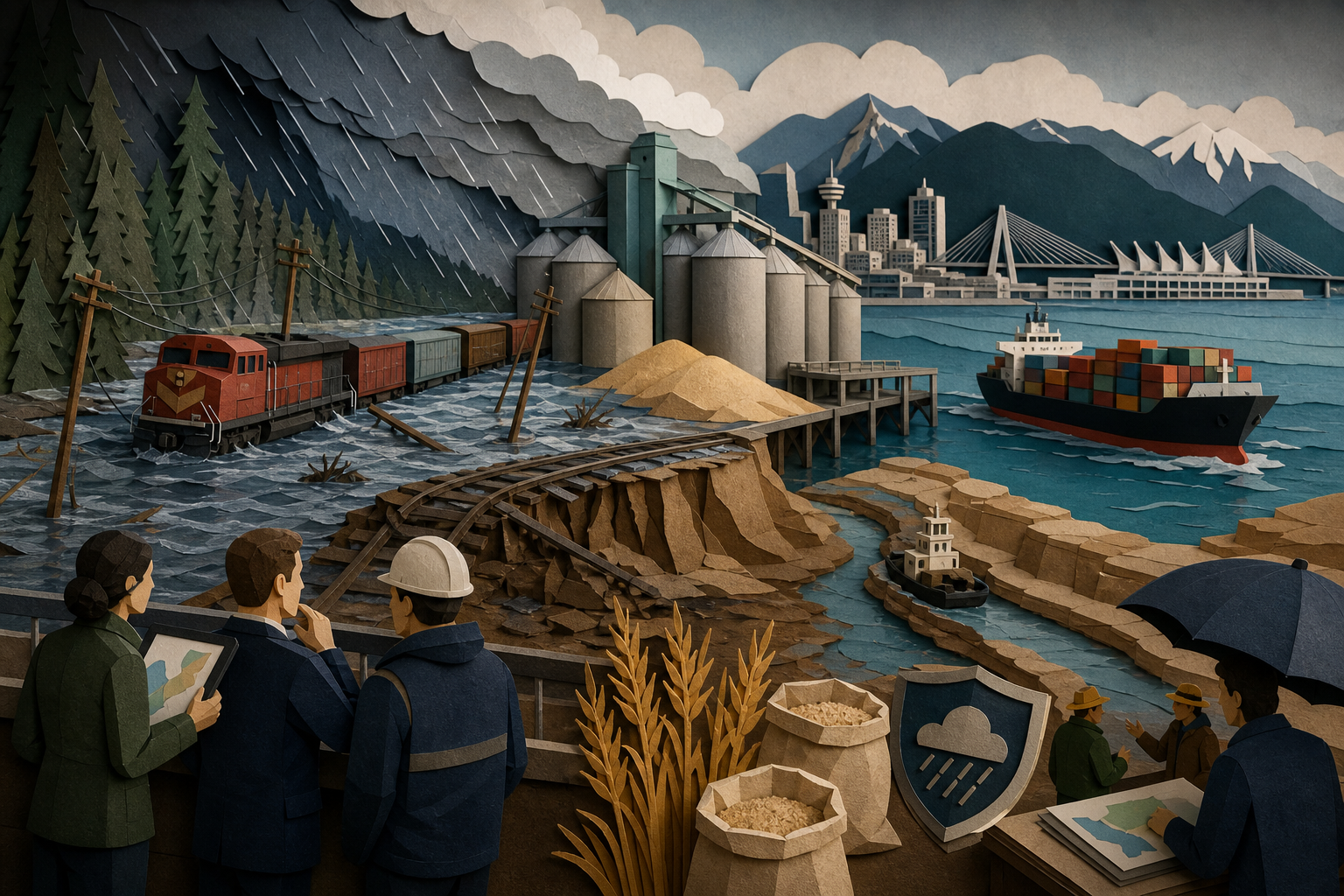

The Port of Vancouver moved 15.3 million tonnes of grain in the first six months of 2025. Then atmospheric rivers flooded the Fraser Valley again, and CP's main line sat underwater for eleven days. Grain futures spiked 18 percent in three trading sessions. By the time the track reopened, forty percent of the year's Prairie wheat export was sitting in silos with nowhere to go, and China had already sourced from Australia instead.
That wasn't a tail risk. It was the fourth rail closure in five years.
Commodity markets are still pricing weather as interruption rather than structure. The standard hedging models, rolling futures, options overlays, variance swaps, assume that supply shocks are mean-reverting: floods happen, prices spike, then the rail lines reopen and prices fall back. The railways don't return to baseline anymore. They degrade. The 2021 Coquihala washout cost $450 million to repair, reopened ten months later, and failed again in the 2024 season. Each time, the repair budget is higher and the corridor is offline longer. The curve doesn't revert. It ratchets.
The insurance industry figured this out three years ago. The Insurance Bureau of Canada reported insured losses from severe weather reached $8.5 billion in 2024, the third consecutive year above $5 billion. Premiums for commodity producers, grain elevators, lumber mills, mining operations, rose between 40 and 60 percent in BC and the Prairies between 2023 and 2026. Those costs don't show up as "climate risk" line items on an income statement. They show up as higher break-even prices, which means the floor on commodity pricing has moved and most hedging strategies are still calibrated to the old one.
The Energy Transition Makes This Worse
The shift to green energy requires copper, lithium, nickel. Lots of it. The problem is that the mines producing those metals are increasingly in water-stressed regions. Highland Valley Copper, BC's largest open-pit operation, relies on snowpack melt to maintain its tailings dams. The 2024 drought season forced a 20 percent production cut because the water wasn't there. Global copper prices rose accordingly, but the futures market treated it as a one-time supply hiccup rather than a recurring constraint. It wasn't. The 2025 and 2026 seasons both saw cuts.
When a mine in a water-scarce region can't operate at capacity three years running, that's not volatility. That's the new supply ceiling. Markets haven't repriced that yet because the conventional view still treats climate as an input to risk models rather than a structural cap on output.
What Happens When Pricing Catches Up
OSFI's B-15 climate risk disclosure rules, phased in fully this year, now require Canadian financial institutions to model physical climate risk in their commodity-linked portfolios. That's forcing a repricing that most commodity desks weren't ready for. When banks model flood frequency using historical data, they underestimate current risk by 30 to 50 percent, per early OSFI filings. When those models get updated to match observed frequency in 2023-2026, the implied risk premium on Prairie grain logistics or BC lumber jumps.
That correction doesn't happen smoothly. It happens in a six-week window when every major lender updates their risk weights at once and suddenly the forward curve for canola or thermal coal has a new floor.
The catch-up will be brutal because markets are backward-looking. The models are trained on decades when a hundred-year flood happened every hundred years. In BC, we've had three in the last six. The models haven't caught up yet, but the weather has, and when the repricing comes it will feel sudden even though the signals have been visible since 2021.
The firms that survive the repricing are the ones building resilience now: dual-corridor logistics, diversified water sources, insurance structures that don't assume the past is a guide. The ones still running last decade's playbook will discover, too late, that their hedge was protecting them from a risk profile that no longer exists.
Sources
Read Next
Asset managers cut product portfolios to fund AI and outsourcing overhauls
ETFs now hold 42% of Canadian fund assets as OSC tightens crypto and liquidity rules
One in Five Canadian Parents Still Pays Bills for Kids in Their Late Thirties
Joint mortgages surge in Ontario and B.C. as first-time buyers face rising delinquency pressure