Kelowna Ranks First Nationally for Wildfire Risk: What Condo Buyers Need to Verify Before Closing
A 47-year-old condo buyer from Alberta recently walked away from a $680,000 purchase in Kelowna's Upper Mission neighborhood after her insurance broker quoted a premium 38% higher than expected and flagged the building's lack of central HEPA filtration. The condo itself was concrete. The view was spectacular. The risk wasn't visible from the listing photos.
Natural Resources Canada's 2026 wildfire risk model now incorporates convective weather patterns, the conditions under which fires create their own wind systems, and that shift has pushed Kelowna into first place nationally. The upgrade isn't cosmetic. The model assigns more weight to topography (Kelowna sits in a bowl-shaped valley that acts as a chimney for smoke and heat), vegetation density in the wildland-urban interface, and historical fire behavior during extreme heat events. The McDougall Creek wildfire in 2023, which destroyed structures across the Central Okanagan, serves as the calibration event for current planning. What used to be modeled as a once-per-generation scenario is now baseline summer risk.
The Concrete Shell Is Not the Weak Point
Most buyers treat "concrete construction" as synonymous with fire safety. That framing misses where the actual vulnerability sits. A concrete high-rise won't ignite the way a wood-frame house will, but embers carried by convective winds land on balconies, in planters, and near vents. The building's HVAC system, if it lacks high-efficiency particulate air (HEPA) filtration, becomes a direct pathway for smoke infiltration during wildfire events that can last days or weeks. Kelowna's "smoke season" now runs from late June through September in bad years, affecting not just immediate safety but the economic viability of short-term rentals and resale marketability.
The City of Kelowna requires a Wildfire Development Permit for construction in designated hazard zones, which cover large portions of Black Mountain and the hillsides above downtown. Buildings constructed after the permit regime took effect (roughly 2018 onward) are likelier to include fire-resistant materials and defensible space. Older buildings were grandfathered. The strata corporation's meeting minutes are where you learn whether post-construction upgrades have been made, and whether the building is FireSmart BC compliant. Non-compliance doesn't just raise premiums. It can result in coverage denial or deductibles so high the strata is functionally self-insuring.
What the Strata Minutes Actually Reveal
Insurance claims in British Columbia multi-family properties now require deductibles ranging from $50,000 to $250,000 depending on the building and the insurer's geospatial risk assessment. If the strata hasn't allocated a reserve for that deductible, or if the building's last engineering report flagged deferred maintenance on roofing or exterior cladding, the strata is one ember strike away from a special levy. Read the last 24 months of minutes. Look for mentions of insurance renewal struggles, premium spikes, or declined quotes. Look for capital planning around HVAC upgrades or "Priority Zone" landscaping, the 1.5-meter perimeter around the building where FireSmart standards prohibit combustible mulch, untrimmed vegetation, and wood decking.
The BC Financial Services Authority reported in 2025 that some insurers are now refusing to issue new policies during active fire season if the property falls within certain geospatial risk polygons. That means a buyer who completes a purchase in July or August may close without coverage, or may pay a temporary rate that resets 60-90 days later at double the quoted premium.
The Premium You Pay for the View
Hillside units command higher prices because of the view. They also sit in the highest-risk fire zones. That premium works in reverse during resale if insurance costs have doubled and smoke events have made the location uninsurable or economically marginal for renters. Density offers some protection, downtown core developments surrounded by asphalt and managed landscaping face lower structural risk than low-density sprawl against forested slopes, but density doesn't solve the air quality problem. The question isn't whether the building will burn. It's whether the building will be livable, insurable, and economically functional during the six-week windows when Kelowna's air quality index reaches hazardous levels and the city smells like a campfire.
Before closing, verify the strata's insurance is locked for the next 12 months. Confirm HEPA filtration exists or is budgeted. Check whether the building sits in a mapped Wildfire Development Permit area, and if so, whether it meets current standards or was grandfathered under old ones. The ranking isn't speculation. The risk is structural.

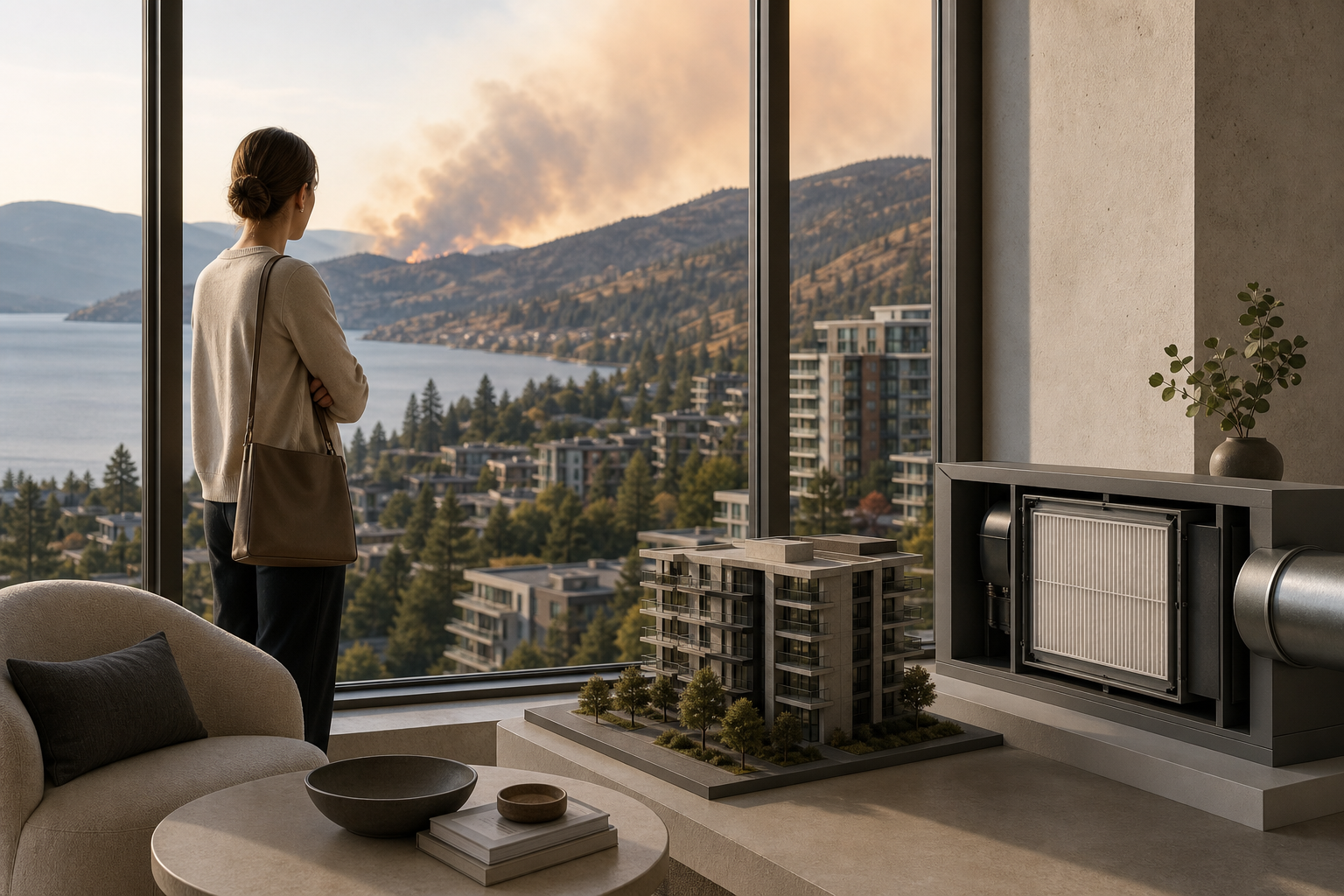

A 47-year-old condo buyer from Alberta recently walked away from a $680,000 purchase in Kelowna's Upper Mission neighborhood after her insurance broker quoted a premium 38% higher than expected and flagged the building's lack of central HEPA filtration. The condo itself was concrete. The view was spectacular. The risk wasn't visible from the listing photos.
Natural Resources Canada's 2026 wildfire risk model now incorporates convective weather patterns, the conditions under which fires create their own wind systems, and that shift has pushed Kelowna into first place nationally. The upgrade isn't cosmetic. The model assigns more weight to topography (Kelowna sits in a bowl-shaped valley that acts as a chimney for smoke and heat), vegetation density in the wildland-urban interface, and historical fire behavior during extreme heat events. The McDougall Creek wildfire in 2023, which destroyed structures across the Central Okanagan, serves as the calibration event for current planning. What used to be modeled as a once-per-generation scenario is now baseline summer risk.
The Concrete Shell Is Not the Weak Point
Most buyers treat "concrete construction" as synonymous with fire safety. That framing misses where the actual vulnerability sits. A concrete high-rise won't ignite the way a wood-frame house will, but embers carried by convective winds land on balconies, in planters, and near vents. The building's HVAC system, if it lacks high-efficiency particulate air (HEPA) filtration, becomes a direct pathway for smoke infiltration during wildfire events that can last days or weeks. Kelowna's "smoke season" now runs from late June through September in bad years, affecting not just immediate safety but the economic viability of short-term rentals and resale marketability.
The City of Kelowna requires a Wildfire Development Permit for construction in designated hazard zones, which cover large portions of Black Mountain and the hillsides above downtown. Buildings constructed after the permit regime took effect (roughly 2018 onward) are likelier to include fire-resistant materials and defensible space. Older buildings were grandfathered. The strata corporation's meeting minutes are where you learn whether post-construction upgrades have been made, and whether the building is FireSmart BC compliant. Non-compliance doesn't just raise premiums. It can result in coverage denial or deductibles so high the strata is functionally self-insuring.
What the Strata Minutes Actually Reveal
Insurance claims in British Columbia multi-family properties now require deductibles ranging from $50,000 to $250,000 depending on the building and the insurer's geospatial risk assessment. If the strata hasn't allocated a reserve for that deductible, or if the building's last engineering report flagged deferred maintenance on roofing or exterior cladding, the strata is one ember strike away from a special levy. Read the last 24 months of minutes. Look for mentions of insurance renewal struggles, premium spikes, or declined quotes. Look for capital planning around HVAC upgrades or "Priority Zone" landscaping, the 1.5-meter perimeter around the building where FireSmart standards prohibit combustible mulch, untrimmed vegetation, and wood decking.
The BC Financial Services Authority reported in 2025 that some insurers are now refusing to issue new policies during active fire season if the property falls within certain geospatial risk polygons. That means a buyer who completes a purchase in July or August may close without coverage, or may pay a temporary rate that resets 60-90 days later at double the quoted premium.
The Premium You Pay for the View
Hillside units command higher prices because of the view. They also sit in the highest-risk fire zones. That premium works in reverse during resale if insurance costs have doubled and smoke events have made the location uninsurable or economically marginal for renters. Density offers some protection, downtown core developments surrounded by asphalt and managed landscaping face lower structural risk than low-density sprawl against forested slopes, but density doesn't solve the air quality problem. The question isn't whether the building will burn. It's whether the building will be livable, insurable, and economically functional during the six-week windows when Kelowna's air quality index reaches hazardous levels and the city smells like a campfire.
Before closing, verify the strata's insurance is locked for the next 12 months. Confirm HEPA filtration exists or is budgeted. Check whether the building sits in a mapped Wildfire Development Permit area, and if so, whether it meets current standards or was grandfathered under old ones. The ranking isn't speculation. The risk is structural.
Read Next
Asset managers cut product portfolios to fund AI and outsourcing overhauls
ETFs now hold 42% of Canadian fund assets as OSC tightens crypto and liquidity rules
One in Five Canadian Parents Still Pays Bills for Kids in Their Late Thirties
Joint mortgages surge in Ontario and B.C. as first-time buyers face rising delinquency pressure