Materials and tech stocks lifted TSX as gold surged past $4,300
Gold traded near $4,350 an ounce on Tuesday, the kind of move that makes mining stocks jump faster than the metal itself. Agnico Eagle and Barrick Gold both posted gains north of 3%, and when Canada's two largest gold producers move in sync like that, the index follows.
The S&P/TSX Composite closed 247 points higher, marking its sharpest advance since early August. Materials led, gaining roughly 2.5% as a sector, while Information Technology, normally a laggard in a high-rate environment, posted its best session in weeks. When both engines fire at once, you get breadth, and breadth is what distinguishes a sustainable rally from a single-sector twitch.
Why Materials Ran
The Materials sector on the TSX is dominated by miners, and miners are leveraged bets on commodity prices. Gold's surge past $2,500 has been building for months, supported by central bank buying, geopolitical hedging, and a weaker U.S. dollar. But the move this week came with volume. Institutional buyers don't just chase price, they chase confirmation that the price will hold.
Copper and potash names also contributed. Teck Resources and Nutrien both climbed, reflecting global demand signals for "green" metals and agricultural inputs. The Materials sector now accounts for roughly 19-20% of the TSX's total weight, behind Financials but ahead of Energy and Tech. When it moves 2.5% in a session, that's enough to carry the entire index even if the banks sit still.
Financials did sit still. The Big Six posted mixed results, with TD and RBC both ending the day flat. That matters because Financials represent more than 30% of the index. A 247-point gain without help from banks is rare.
Tech's Unexpected Lift
The Technology sector's contribution is harder to explain but equally important. Shopify, which still represents a disproportionate share of the TSX's tech weighting, gained 2.8%. That alone accounted for a measurable portion of the index's move.
But the lift wasn't just Shopify. Mid-cap names in AI-integrated software and logistics tech posted gains as well, suggesting a sector-wide shift in sentiment rather than a single-stock event. The Bank of Canada's recent signals that it may be nearing the end of its tightening cycle have lowered the discount rate investors apply to future tech earnings. Lower discount rates mean higher valuations, all else equal.
Tech rallies on the TSX are fragile. The sector lacks depth. Remove Shopify, and you're left with a handful of mid-caps and a long tail of small, illiquid names. But when sentiment shifts, even shallow rallies can produce real gains for index funds.
What the Two-Engine Rally Signals
Rallies driven by a single sector are common. Rallies driven by two unrelated sectors, one cyclical, one growth, are less common and carry more information. They suggest that market participants are rotating into multiple types of risk at once, which typically happens when expectations about rates, growth, or both shift in a meaningful way.
Financials, Energy, and Materials together represent over 60% of the TSX's weight. That concentration makes it a proxy for global commodity demand and Canadian bank health, not for the Canadian economy as a whole. When Materials and Tech rally together, what you're seeing is a bet on global growth (via commodities) combined with a bet on falling rates (via tech multiples).
Whether this holds depends on what happens next with gold, copper, and the Bank of Canada's policy stance. One-day moves are not trends. But Tuesday's session was the first time in a month that the TSX showed genuine breadth, and breadth is what bull markets are made of.

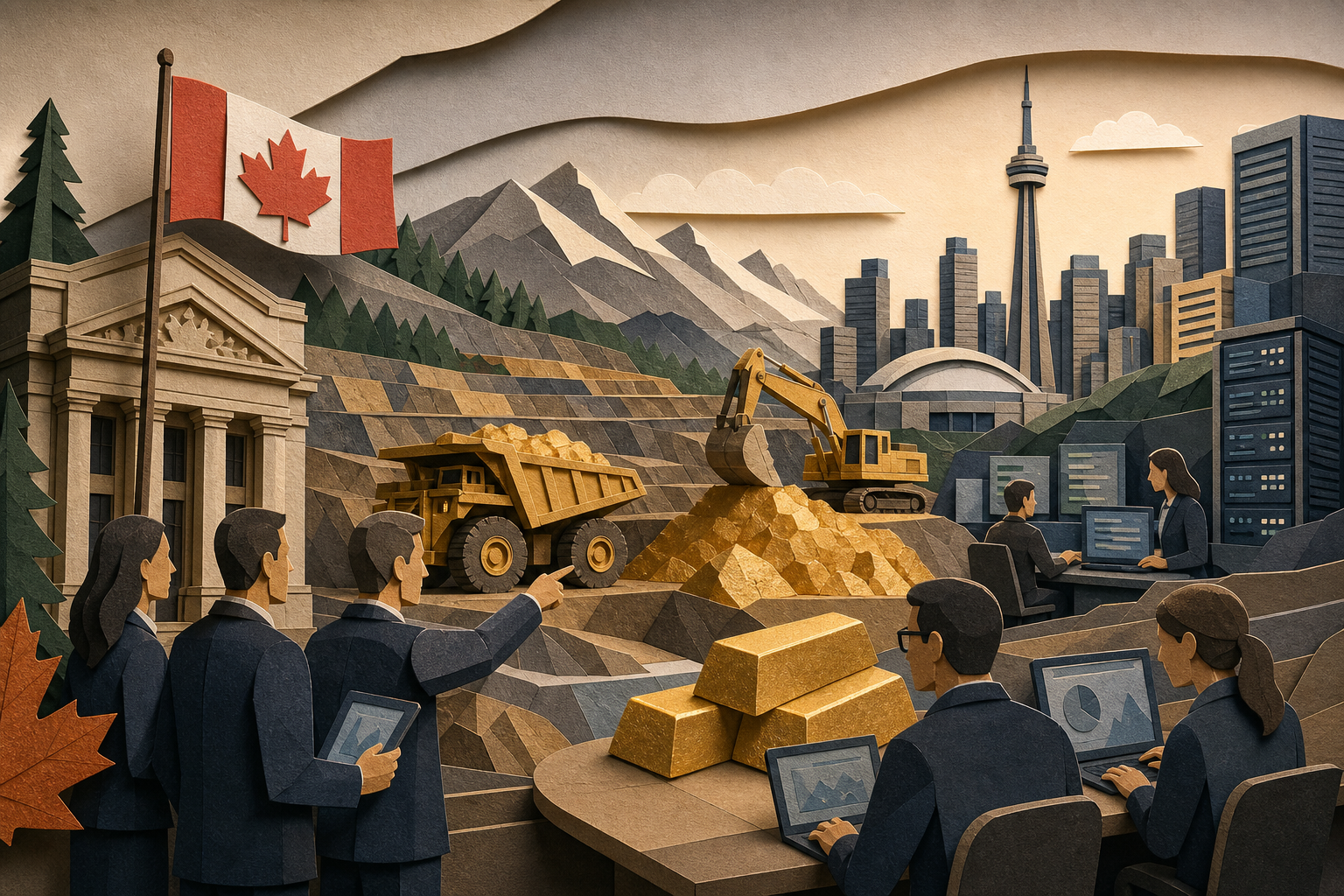

Gold traded near $4,350 an ounce on Tuesday, the kind of move that makes mining stocks jump faster than the metal itself. Agnico Eagle and Barrick Gold both posted gains north of 3%, and when Canada's two largest gold producers move in sync like that, the index follows.
The S&P/TSX Composite closed 247 points higher, marking its sharpest advance since early August. Materials led, gaining roughly 2.5% as a sector, while Information Technology, normally a laggard in a high-rate environment, posted its best session in weeks. When both engines fire at once, you get breadth, and breadth is what distinguishes a sustainable rally from a single-sector twitch.
Why Materials Ran
The Materials sector on the TSX is dominated by miners, and miners are leveraged bets on commodity prices. Gold's surge past $2,500 has been building for months, supported by central bank buying, geopolitical hedging, and a weaker U.S. dollar. But the move this week came with volume. Institutional buyers don't just chase price, they chase confirmation that the price will hold.
Copper and potash names also contributed. Teck Resources and Nutrien both climbed, reflecting global demand signals for "green" metals and agricultural inputs. The Materials sector now accounts for roughly 19-20% of the TSX's total weight, behind Financials but ahead of Energy and Tech. When it moves 2.5% in a session, that's enough to carry the entire index even if the banks sit still.
Financials did sit still. The Big Six posted mixed results, with TD and RBC both ending the day flat. That matters because Financials represent more than 30% of the index. A 247-point gain without help from banks is rare.
Tech's Unexpected Lift
The Technology sector's contribution is harder to explain but equally important. Shopify, which still represents a disproportionate share of the TSX's tech weighting, gained 2.8%. That alone accounted for a measurable portion of the index's move.
But the lift wasn't just Shopify. Mid-cap names in AI-integrated software and logistics tech posted gains as well, suggesting a sector-wide shift in sentiment rather than a single-stock event. The Bank of Canada's recent signals that it may be nearing the end of its tightening cycle have lowered the discount rate investors apply to future tech earnings. Lower discount rates mean higher valuations, all else equal.
Tech rallies on the TSX are fragile. The sector lacks depth. Remove Shopify, and you're left with a handful of mid-caps and a long tail of small, illiquid names. But when sentiment shifts, even shallow rallies can produce real gains for index funds.
What the Two-Engine Rally Signals
Rallies driven by a single sector are common. Rallies driven by two unrelated sectors, one cyclical, one growth, are less common and carry more information. They suggest that market participants are rotating into multiple types of risk at once, which typically happens when expectations about rates, growth, or both shift in a meaningful way.
Financials, Energy, and Materials together represent over 60% of the TSX's weight. That concentration makes it a proxy for global commodity demand and Canadian bank health, not for the Canadian economy as a whole. When Materials and Tech rally together, what you're seeing is a bet on global growth (via commodities) combined with a bet on falling rates (via tech multiples).
Whether this holds depends on what happens next with gold, copper, and the Bank of Canada's policy stance. One-day moves are not trends. But Tuesday's session was the first time in a month that the TSX showed genuine breadth, and breadth is what bull markets are made of.
Sources
Read Next
Asset managers cut product portfolios to fund AI and outsourcing overhauls
ETFs now hold 42% of Canadian fund assets as OSC tightens crypto and liquidity rules
One in Five Canadian Parents Still Pays Bills for Kids in Their Late Thirties
Joint mortgages surge in Ontario and B.C. as first-time buyers face rising delinquency pressure