Mortgage Defaults Below 0.5% Mean Lenders Already Tightened the Gates
The Bank of Canada started cutting rates in late 2024, and mortgage arrears just hit 0.19%, the lowest level in a decade. If you're waiting for lenders to loosen up, you're reading that number backwards.
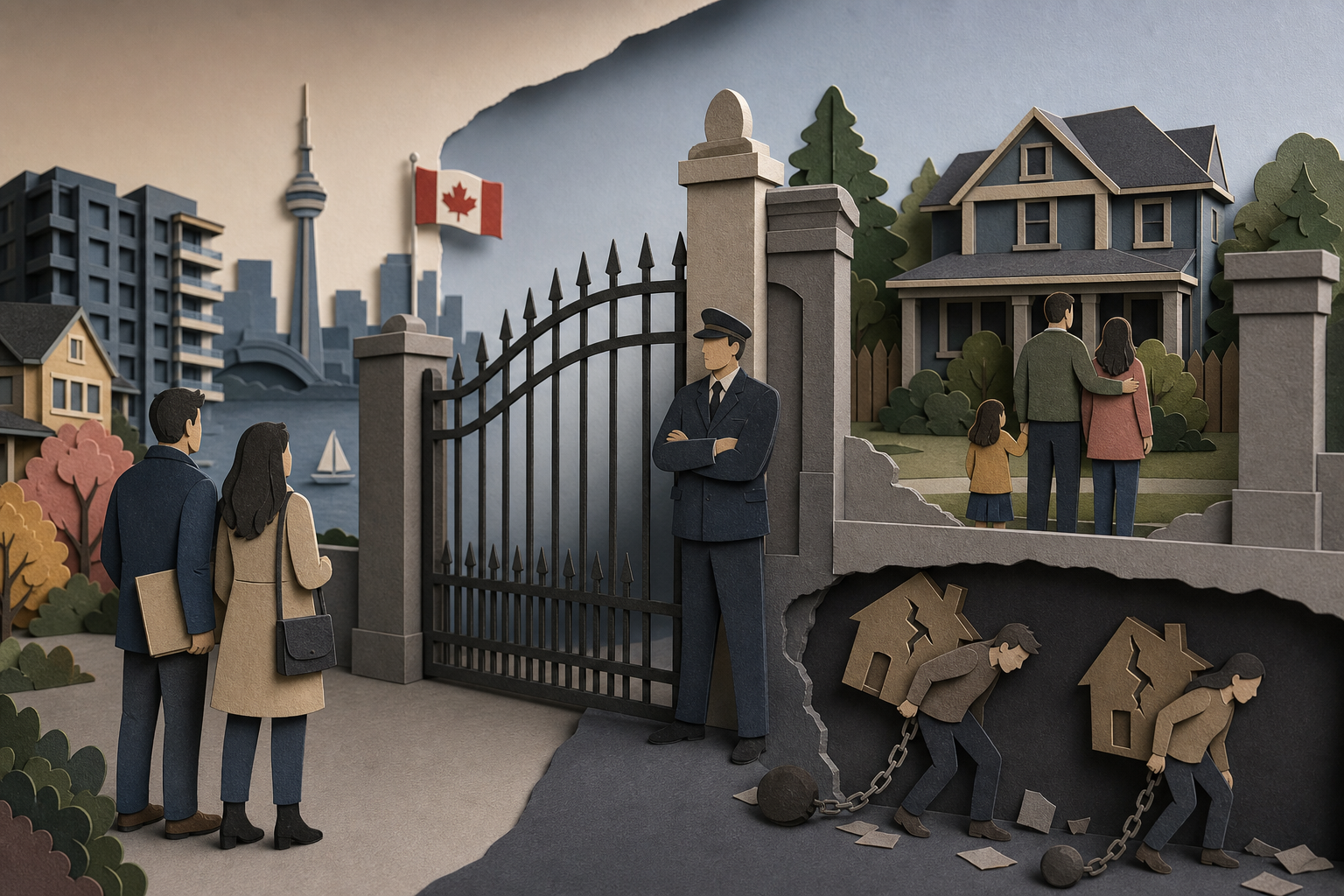
Defaults this low don't mean the system is healthy and open for business. They mean the credit box already shrank. When arrears sit at 0.19% against a long-term average of 0.26% to 0.50%, what you're seeing is gatekeeping. The only people getting mortgages are the ones who could qualify during a stress test designed for a world that no longer exists.
The Stress Test Didn't Move
OSFI's Guideline B-20 still requires you to qualify at the higher of your contract rate plus 200 basis points, or 5.25%. If you're locking in at 4.5% today, you still have to prove you can carry 6.5%. The stress test is a wall, especially now that five-year fixed rates are at 4.5% instead of the 1.79% they were in 2021. It's a mechanism that keeps most self-employed borrowers and leveraged investors out entirely.
The stress test was supposed to protect against rate shock. But rates already shocked. The people who locked in at sub-2% in 2021 are renewing now at 5.4%. They're not defaulting because banks gave them extended amortizations and internal renewals to keep them afloat. That kept the arrears number clean, but it didn't restore access. It just turned existing borrowers into zombie positions with equity they can't touch.
Self-Employed Borrowers Got Locked Out First
CMHC now requires 24 months of financial statements for self-employed applicants. OSFI quietly applies a 15% haircut to self-employed income during underwriting, even when the statements are clean. If you had a lean year in 2025 because you reinvested profits or your T4A came in light, you're not qualifying in 2026, rate cuts or not.
Lenders are prioritizing Debt Service Coverage Ratios over everything else. For investors, that means proving your rental income covers the mortgage at the stress test rate, with a margin. If your property cash flows at 5.4% but not at 6.5%, you're out. The gate isn't rates. It's documentation and ratios that assume worst-case conditions as the baseline.
Rate Cuts Take 18 Months to Matter
Monetary policy works on a lag. The Bank of Canada cuts the overnight rate, but qualification standards are set by OSFI and enforced by individual lenders who are still in risk-off mode. As of mid-2026, roughly $300 billion in mortgages are renewing over the next 12 months. Most of those borrowers locked in between 2020 and 2021. They're transitioning from sub-2% to current market rates, and lenders are treating them like new applicants.
The default rate you're seeing today reflects the financial health of borrowers approved in 2023. If the labour market softens in late 2026, arrears could spike regardless of where the overnight rate sits. But that lag also means the relief investors expect from 2025-2026 cuts won't translate into easier approvals until late 2026 or 2027. By then, the credit environment will have been tight for three years straight.
Access Became More Valuable Than Cost
In a tight lending environment, your ability to qualify matters more than the rate you lock in at. A 4.5% mortgage you can't access is worse than a 5.9% mortgage you can. That's the calculation most investors are missing. The constraint is whether lenders will insure the mortgage, not the cost.
If you're self-employed, the priority should be documenting clean 24-month financials now, not timing the market for the perfect rate. If you're an investor, your next move is proving DSCR on existing properties. Lenders tightened because they saw volatility. The overnight rate dropped 150 basis points and they haven't loosened.
The default rate is low because the people who couldn't qualify never got mortgages in the first place. That's a signal of exclusion.


The Bank of Canada started cutting rates in late 2024, and mortgage arrears just hit 0.19%, the lowest level in a decade. If you're waiting for lenders to loosen up, you're reading that number backwards.
Defaults this low don't mean the system is healthy and open for business. They mean the credit box already shrank. When arrears sit at 0.19% against a long-term average of 0.26% to 0.50%, what you're seeing is gatekeeping. The only people getting mortgages are the ones who could qualify during a stress test designed for a world that no longer exists.
The Stress Test Didn't Move
OSFI's Guideline B-20 still requires you to qualify at the higher of your contract rate plus 200 basis points, or 5.25%. If you're locking in at 4.5% today, you still have to prove you can carry 6.5%. The stress test is a wall, especially now that five-year fixed rates are at 4.5% instead of the 1.79% they were in 2021. It's a mechanism that keeps most self-employed borrowers and leveraged investors out entirely.
The stress test was supposed to protect against rate shock. But rates already shocked. The people who locked in at sub-2% in 2021 are renewing now at 5.4%. They're not defaulting because banks gave them extended amortizations and internal renewals to keep them afloat. That kept the arrears number clean, but it didn't restore access. It just turned existing borrowers into zombie positions with equity they can't touch.
Self-Employed Borrowers Got Locked Out First
CMHC now requires 24 months of financial statements for self-employed applicants. OSFI quietly applies a 15% haircut to self-employed income during underwriting, even when the statements are clean. If you had a lean year in 2025 because you reinvested profits or your T4A came in light, you're not qualifying in 2026, rate cuts or not.
Lenders are prioritizing Debt Service Coverage Ratios over everything else. For investors, that means proving your rental income covers the mortgage at the stress test rate, with a margin. If your property cash flows at 5.4% but not at 6.5%, you're out. The gate isn't rates. It's documentation and ratios that assume worst-case conditions as the baseline.
Rate Cuts Take 18 Months to Matter
Monetary policy works on a lag. The Bank of Canada cuts the overnight rate, but qualification standards are set by OSFI and enforced by individual lenders who are still in risk-off mode. As of mid-2026, roughly $300 billion in mortgages are renewing over the next 12 months. Most of those borrowers locked in between 2020 and 2021. They're transitioning from sub-2% to current market rates, and lenders are treating them like new applicants.
The default rate you're seeing today reflects the financial health of borrowers approved in 2023. If the labour market softens in late 2026, arrears could spike regardless of where the overnight rate sits. But that lag also means the relief investors expect from 2025-2026 cuts won't translate into easier approvals until late 2026 or 2027. By then, the credit environment will have been tight for three years straight.
Access Became More Valuable Than Cost
In a tight lending environment, your ability to qualify matters more than the rate you lock in at. A 4.5% mortgage you can't access is worse than a 5.9% mortgage you can. That's the calculation most investors are missing. The constraint is whether lenders will insure the mortgage, not the cost.
If you're self-employed, the priority should be documenting clean 24-month financials now, not timing the market for the perfect rate. If you're an investor, your next move is proving DSCR on existing properties. Lenders tightened because they saw volatility. The overnight rate dropped 150 basis points and they haven't loosened.
The default rate is low because the people who couldn't qualify never got mortgages in the first place. That's a signal of exclusion.
Read Next
Asset managers cut product portfolios to fund AI and outsourcing overhauls
ETFs now hold 42% of Canadian fund assets as OSC tightens crypto and liquidity rules
One in Five Canadian Parents Still Pays Bills for Kids in Their Late Thirties
Joint mortgages surge in Ontario and B.C. as first-time buyers face rising delinquency pressure