The $9,000 Nobody Budgets: What First-Quarter Homeownership Actually Costs in Canada
A Victoria couple closed on their first house in February 2026 with $800 left in checking. They'd scraped together 20% down on a $950,000 Oak Bay semi-detached and paid the closing costs. What they couldn't pay for: the locksmith ($340), the utility deposits ($450), the lawnmower their new yard required ($680), or the $1,100 it cost to stock the kitchen and buy a drill, ladder, and basic hand tools. By April they'd racked up $4,200 on a credit card at 21.99% interest. The house was an asset. The first 90 days made them poorer.
Most first-time buyers in British Columbia budget aggressively for the down payment and the Property Transfer Tax. Almost none budget for what it costs to make the house work as a house. The gap between "keys in hand" and "functional home" runs between $9,000 and $25,000 for a typical Victoria-area detached property, depending on what you're moving from and what the house needs immediately.
What the 1-2% reserve actually covers
The rule is simple: set aside 1 to 2% of your purchase price in cash you do not touch until you own the house. On a $1.25 million single-family home, the current Victoria average, that's $12,500 to $25,000. This is not your emergency fund. This is not your renovation budget. It is the operational cash required to turn an empty structure into a place you can live and maintain without going into debt in month one.
Security and access
New owners in BC without a local credit history often face security deposits from BC Hydro or FortisBC, typically $200 to $400 per utility. Add another $250 to $400 to re-key all exterior doors, locksmith costs in Victoria run higher than the BC Interior, and you should never trust the previous owner's key distribution. If the house uses a smart lock or security system, budget $300 to $800 to replace or reconfigure it. Former renters rarely budget for any of this.
Tools and seasonal equipment
A Saanich bungalow with a 5,000-square-foot lot requires a lawnmower, rake, edger, hose, and basic garden tools. Entry-level versions of all five run $900 to $1,400. If you're moving from a condo, you also need a drill, hammer, level, step ladder, and screwdriver set, another $400 minimum. A snow shovel and driveway salt for a Malahat-area property add $80. These aren't lifestyle purchases. They're baseline operational costs.
Kitchen and cleaning startup
It's not just appliances. A functional kitchen for two adults requires roughly $600 in pantry staples, cleaning supplies, trash bins, and basic cookware if you're starting from scratch. Add $500 to $900 for a professional move-in deep clean, Victoria's older housing stock often needs it, especially in basements and around windows. Buyers moving from furnished rentals consistently underestimate this line.
Digital infrastructure
In 2026 a house isn't secure or functional without reliable Wi-Fi. Larger Victoria heritage homes, common in Fairfield, James Bay, and Fernwood, have thick plaster walls that kill standard router signals. A mesh network system runs $400 to $1,000 depending on square footage. Smart locks, video doorbells, and basic home monitoring add another $300 to $600. These are no longer nice-to-haves. They're how you control access and monitor the property when you're not there.
Why this isn't your maintenance budget
The 1-2% reserve is distinct from the annual maintenance budget, which covers predictable upkeep like furnace servicing and gutter cleaning. The first-quarter reserve handles the once-off capital costs of starting to live in and care for the house. Conflating the two leaves buyers underfunded for both.
Mortgage brokers who present this heuristic before clients drain their liquidity move from transactional lender to financial advisor. The conversation costs nothing. The avoided credit card debt compounds for years.

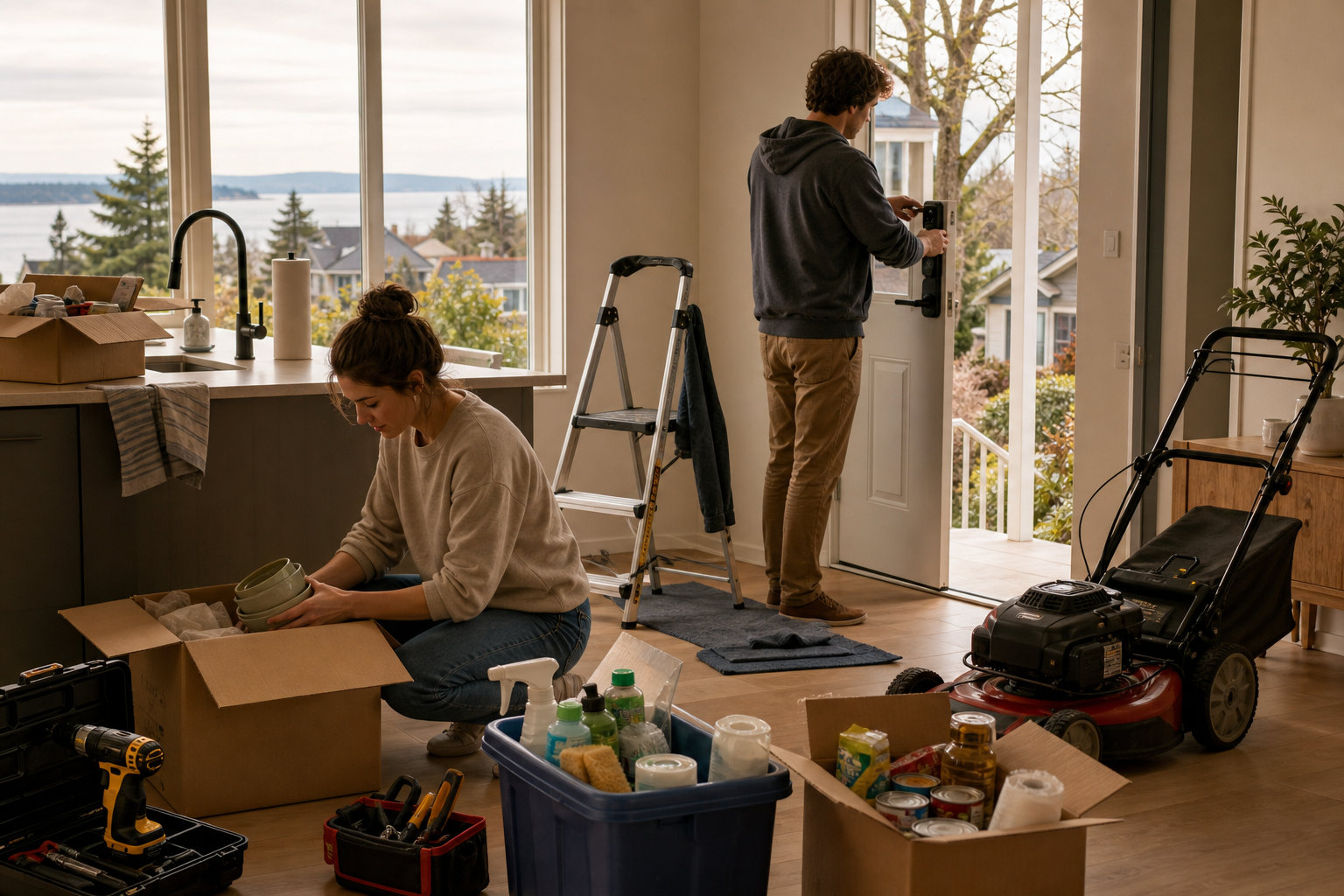

A Victoria couple closed on their first house in February 2026 with $800 left in checking. They'd scraped together 20% down on a $950,000 Oak Bay semi-detached and paid the closing costs. What they couldn't pay for: the locksmith ($340), the utility deposits ($450), the lawnmower their new yard required ($680), or the $1,100 it cost to stock the kitchen and buy a drill, ladder, and basic hand tools. By April they'd racked up $4,200 on a credit card at 21.99% interest. The house was an asset. The first 90 days made them poorer.
Most first-time buyers in British Columbia budget aggressively for the down payment and the Property Transfer Tax. Almost none budget for what it costs to make the house work as a house. The gap between "keys in hand" and "functional home" runs between $9,000 and $25,000 for a typical Victoria-area detached property, depending on what you're moving from and what the house needs immediately.
What the 1-2% reserve actually covers
The rule is simple: set aside 1 to 2% of your purchase price in cash you do not touch until you own the house. On a $1.25 million single-family home, the current Victoria average, that's $12,500 to $25,000. This is not your emergency fund. This is not your renovation budget. It is the operational cash required to turn an empty structure into a place you can live and maintain without going into debt in month one.
Security and access
New owners in BC without a local credit history often face security deposits from BC Hydro or FortisBC, typically $200 to $400 per utility. Add another $250 to $400 to re-key all exterior doors, locksmith costs in Victoria run higher than the BC Interior, and you should never trust the previous owner's key distribution. If the house uses a smart lock or security system, budget $300 to $800 to replace or reconfigure it. Former renters rarely budget for any of this.
Tools and seasonal equipment
A Saanich bungalow with a 5,000-square-foot lot requires a lawnmower, rake, edger, hose, and basic garden tools. Entry-level versions of all five run $900 to $1,400. If you're moving from a condo, you also need a drill, hammer, level, step ladder, and screwdriver set, another $400 minimum. A snow shovel and driveway salt for a Malahat-area property add $80. These aren't lifestyle purchases. They're baseline operational costs.
Kitchen and cleaning startup
It's not just appliances. A functional kitchen for two adults requires roughly $600 in pantry staples, cleaning supplies, trash bins, and basic cookware if you're starting from scratch. Add $500 to $900 for a professional move-in deep clean, Victoria's older housing stock often needs it, especially in basements and around windows. Buyers moving from furnished rentals consistently underestimate this line.
Digital infrastructure
In 2026 a house isn't secure or functional without reliable Wi-Fi. Larger Victoria heritage homes, common in Fairfield, James Bay, and Fernwood, have thick plaster walls that kill standard router signals. A mesh network system runs $400 to $1,000 depending on square footage. Smart locks, video doorbells, and basic home monitoring add another $300 to $600. These are no longer nice-to-haves. They're how you control access and monitor the property when you're not there.
Why this isn't your maintenance budget
The 1-2% reserve is distinct from the annual maintenance budget, which covers predictable upkeep like furnace servicing and gutter cleaning. The first-quarter reserve handles the once-off capital costs of starting to live in and care for the house. Conflating the two leaves buyers underfunded for both.
Mortgage brokers who present this heuristic before clients drain their liquidity move from transactional lender to financial advisor. The conversation costs nothing. The avoided credit card debt compounds for years.
Read Next
Asset managers cut product portfolios to fund AI and outsourcing overhauls
ETFs now hold 42% of Canadian fund assets as OSC tightens crypto and liquidity rules
One in Five Canadian Parents Still Pays Bills for Kids in Their Late Thirties
Joint mortgages surge in Ontario and B.C. as first-time buyers face rising delinquency pressure