Toronto's Penthouse Market Is Breaking Away From the Broader Condo Slowdown
Last year, Toronto saw a 200% year-over-year increase in sales of homes priced above $10 million. That number sounds staggering until you realize it's being calculated from a small base, a handful of transactions can triple when the starting point is already single digits. But the growth is real, and it's happening while standard condos are sitting on the market for weeks longer than they did two years ago.
The divergence isn't subtle. According to TRREB data, average days on market for typical GTA condos hovered around 25 to 30 days through 2025. Premium penthouses in what brokers call "Platinum" buildings, Four Seasons, 155 Cumberland, No. 7 Rosedale, were moving in under 14 days when priced correctly. The gap isn't about marketing. It's about who's buying and what they're optimizing for.
The Buyer Profile Has Changed
The $10 million penthouse buyer in 2026 is not the offshore investor parking capital in a glass tower. The federal ban on non-resident purchases, now extended through 2027, closed that channel almost entirely. What's left is domestic wealth, and most of it isn't speculative.
A significant portion of current demand is coming from what the industry calls "right-sizing downsizers", affluent locals who are selling $15 million detached homes in Rosedale or Forest Hill and moving into managed luxury spaces. They're not fleeing the market. They're reallocating. The $10 million penthouse becomes a liquidity event that frees up $5 million for family trusts or other holdings while maintaining the same postal code and eliminating yard maintenance.
This isn't new money chasing returns. It's old money restructuring.
What Counts as a Penthouse Now
The product itself has shifted. A penthouse used to mean the top floor. Now it means a custom-built vertical estate: private elevator, multi-car heated garage, and at minimum a 1,000-square-foot terrace. In the $10 million bracket, outdoor space has become the primary differentiator. A unit without substantial private exterior space is considered a compromised asset regardless of interior finishes.
Luxury is also moving toward smaller, more exclusive buildings. The 60-storey tower with 400 units has lost its appeal to buyers who want privacy and invisible service. Boutique developments of four to ten storeys, often in Yorkville or along the Forest Hill corridor, are commanding between $2,500 and $3,500 per square foot. The appeal isn't the address alone, it's the ability to move through a building without encountering anyone.
Policy Hasn't Slowed the Top
Toronto's municipal land transfer tax includes tiered rates for high-value properties, implemented in late 2023 for transactions over $3 million. The added cost on a $10 million penthouse can run into six figures. It hasn't deterred buyers. At this price point, most purchases are cash or private wealth management, backed, making them immune to mortgage rate volatility. The transaction costs are absorbed as part of the total capital deployment, not weighed against monthly carrying costs.
This creates a practical floor. Buyers who are sensitive to closing costs aren't shopping at $10 million. The ones who are don't adjust their behavior based on a 25% non-resident speculation tax or an extra point on the land transfer calculation.
Inventory Scarcity Reinforces Pricing
There is a finite number of addresses that meet the criteria buyers at this level are optimizing for. When a penthouse in one of those buildings comes to market, it's often the only comparable listing available. Scarcity isn't artificial, it's structural. You can't build more Four Seasons Residences.
This explains why sales volume can jump 200% while the broader market stalls. The $10 million segment isn't large enough to move in tandem with general sentiment. It moves when a small number of high-net-worth individuals decide to transact, and that timing is driven more by estate planning and portfolio rebalancing than by interest rate policy.

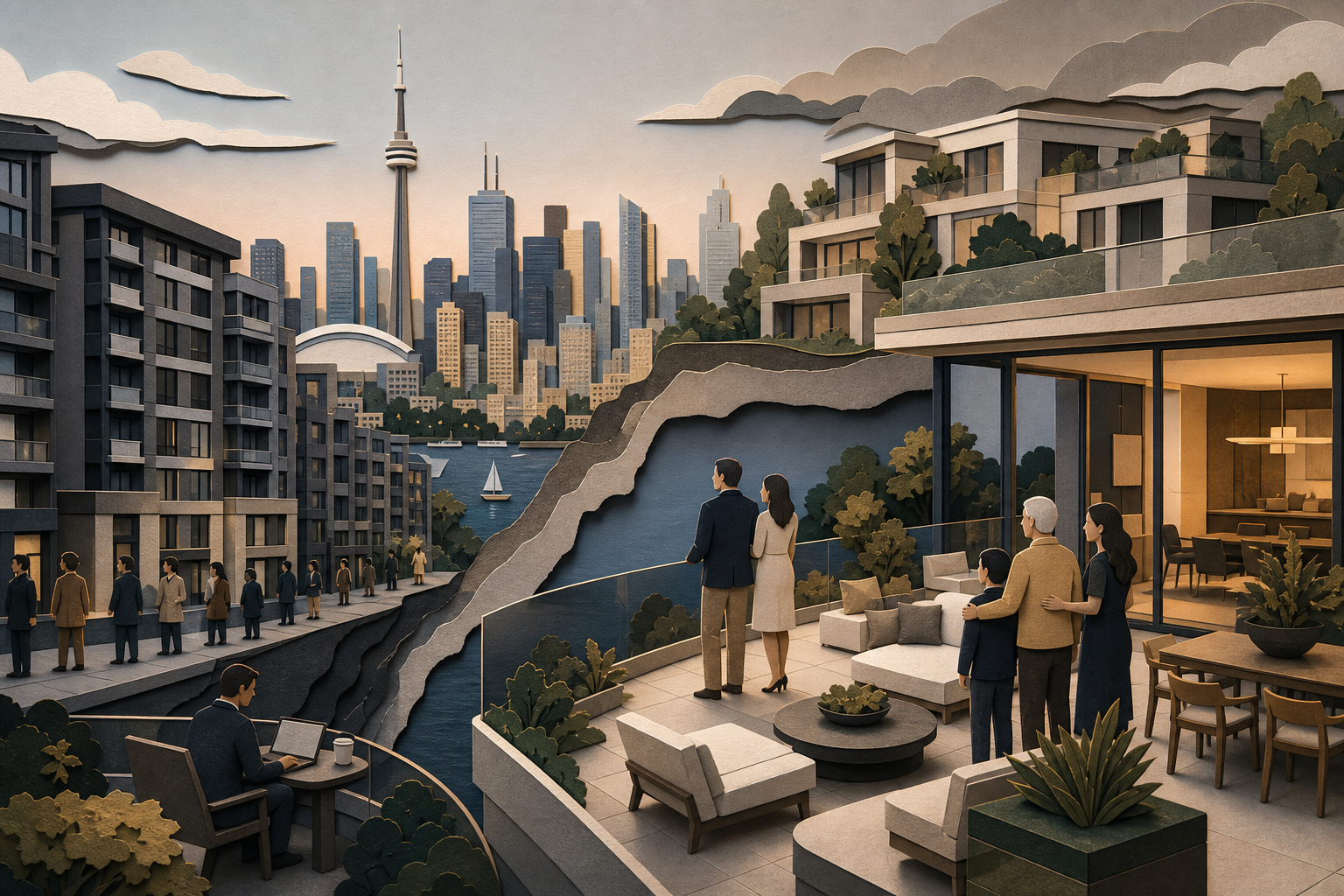

Last year, Toronto saw a 200% year-over-year increase in sales of homes priced above $10 million. That number sounds staggering until you realize it's being calculated from a small base, a handful of transactions can triple when the starting point is already single digits. But the growth is real, and it's happening while standard condos are sitting on the market for weeks longer than they did two years ago.
The divergence isn't subtle. According to TRREB data, average days on market for typical GTA condos hovered around 25 to 30 days through 2025. Premium penthouses in what brokers call "Platinum" buildings, Four Seasons, 155 Cumberland, No. 7 Rosedale, were moving in under 14 days when priced correctly. The gap isn't about marketing. It's about who's buying and what they're optimizing for.
The Buyer Profile Has Changed
The $10 million penthouse buyer in 2026 is not the offshore investor parking capital in a glass tower. The federal ban on non-resident purchases, now extended through 2027, closed that channel almost entirely. What's left is domestic wealth, and most of it isn't speculative.
A significant portion of current demand is coming from what the industry calls "right-sizing downsizers", affluent locals who are selling $15 million detached homes in Rosedale or Forest Hill and moving into managed luxury spaces. They're not fleeing the market. They're reallocating. The $10 million penthouse becomes a liquidity event that frees up $5 million for family trusts or other holdings while maintaining the same postal code and eliminating yard maintenance.
This isn't new money chasing returns. It's old money restructuring.
What Counts as a Penthouse Now
The product itself has shifted. A penthouse used to mean the top floor. Now it means a custom-built vertical estate: private elevator, multi-car heated garage, and at minimum a 1,000-square-foot terrace. In the $10 million bracket, outdoor space has become the primary differentiator. A unit without substantial private exterior space is considered a compromised asset regardless of interior finishes.
Luxury is also moving toward smaller, more exclusive buildings. The 60-storey tower with 400 units has lost its appeal to buyers who want privacy and invisible service. Boutique developments of four to ten storeys, often in Yorkville or along the Forest Hill corridor, are commanding between $2,500 and $3,500 per square foot. The appeal isn't the address alone, it's the ability to move through a building without encountering anyone.
Policy Hasn't Slowed the Top
Toronto's municipal land transfer tax includes tiered rates for high-value properties, implemented in late 2023 for transactions over $3 million. The added cost on a $10 million penthouse can run into six figures. It hasn't deterred buyers. At this price point, most purchases are cash or private wealth management, backed, making them immune to mortgage rate volatility. The transaction costs are absorbed as part of the total capital deployment, not weighed against monthly carrying costs.
This creates a practical floor. Buyers who are sensitive to closing costs aren't shopping at $10 million. The ones who are don't adjust their behavior based on a 25% non-resident speculation tax or an extra point on the land transfer calculation.
Inventory Scarcity Reinforces Pricing
There is a finite number of addresses that meet the criteria buyers at this level are optimizing for. When a penthouse in one of those buildings comes to market, it's often the only comparable listing available. Scarcity isn't artificial, it's structural. You can't build more Four Seasons Residences.
This explains why sales volume can jump 200% while the broader market stalls. The $10 million segment isn't large enough to move in tandem with general sentiment. It moves when a small number of high-net-worth individuals decide to transact, and that timing is driven more by estate planning and portfolio rebalancing than by interest rate policy.
Read Next
Asset managers cut product portfolios to fund AI and outsourcing overhauls
ETFs now hold 42% of Canadian fund assets as OSC tightens crypto and liquidity rules
One in Five Canadian Parents Still Pays Bills for Kids in Their Late Thirties
Joint mortgages surge in Ontario and B.C. as first-time buyers face rising delinquency pressure