Trade Deal Buys Housing Market Time, Unless Rates Turn
The Bank of Canada cut its overnight rate by 0.5% in July, and the sales-to-new-listings ratio barely moved. Toronto condo inventory sat at 33 days on market in mid-August because nobody is listing. The housing market isn't frozen by cost alone. It's frozen by uncertainty, and a finalized trade agreement with the United States might be the only thing capable of thawing it before 2027.
Canada ships roughly $3.6 billion in goods across the border daily. When that flow is stable, developers can forecast the cost of lumber, steel, appliances, and subflooring with enough confidence to break ground. When it isn't, they sit on zoned land and wait. The CUSMA review in 2026 turned what should have been routine into a negotiating window, and the construction industry responded the way it always does to policy risk: by not building.
Why Lumber Costs More Than You Think
Softwood lumber duties have historically bounced between 8% and 15%, depending on which round of the trade war we're in. A 10% swing on framing lumber for a 2,200-square-foot detached build in suburban Mississauga adds roughly $4,000 to $6,000 in material costs before the general contractor's markup. That's manageable in a hot market where buyers stretch. It's a deal-killer in a market where the average household is carrying a debt-to-disposable-income ratio near 175% and has no room for a surprise $8,000 floor-price bump.
A stable trade deal removes the variance. Developers can lock a bid and know the number will hold for 18 months. They need that certainty to break ground on a new site.
The Paradox Nobody's Talking About
Here's the structural problem: if a trade deal works the way it's supposed to, it boosts cross-border investment, stabilizes employment in export-heavy sectors, and gives the overall economy a confidence jolt. That jolt is inflationary. The Bank of Canada, which spent 2022 and 2023 hiking rates to kill inflation, would have no choice but to hold rates higher for longer, or even reverse course if GDP growth accelerates too quickly.
The housing market doesn't benefit from a trade deal in that scenario. It gets crushed by it.
The people who refinanced fixed-rate mortgages in 2021 at 1.79% are starting to renew now at rates above 5%. A household in Etobicoke carrying a $650,000 mortgage that was costing $2,400 a month is now looking at $3,600. Add another 0.25% because trade-driven inflation forced the Bank to pause cuts, and that's another $85 a month. Multiply that across two million renewal households between now and 2028, and you have a consumer spending contraction regardless of what the trade deal does for business confidence.
The Buyer Who Isn't There Yet
The sidelined buyer, the one with 15% down, stable income, and a pre-approval sitting in a drawer, is not waiting for a better interest rate. Rates have come down. They're waiting for a reason to believe the next 24 months won't be worse than the last 24. A signed trade deal, particularly one that removes the threat of retaliatory tariffs on Canadian exports, gives that buyer permission to move.
The developer already has the land. The buyer already has the income. What neither of them has is certainty that the macro environment won't collapse the deal halfway through. Trade policy doesn't create housing demand, but it does release the demand that's already there and waiting for a signal.
The problem is timing. Trade negotiations take months to filter into construction starts, and construction starts take 18 months to become occupied units. If the Bank of Canada hikes rates in response to trade-driven growth before those units hit the market, the whole cycle stalls again. The deal buys time. It doesn't guarantee the time gets used well.

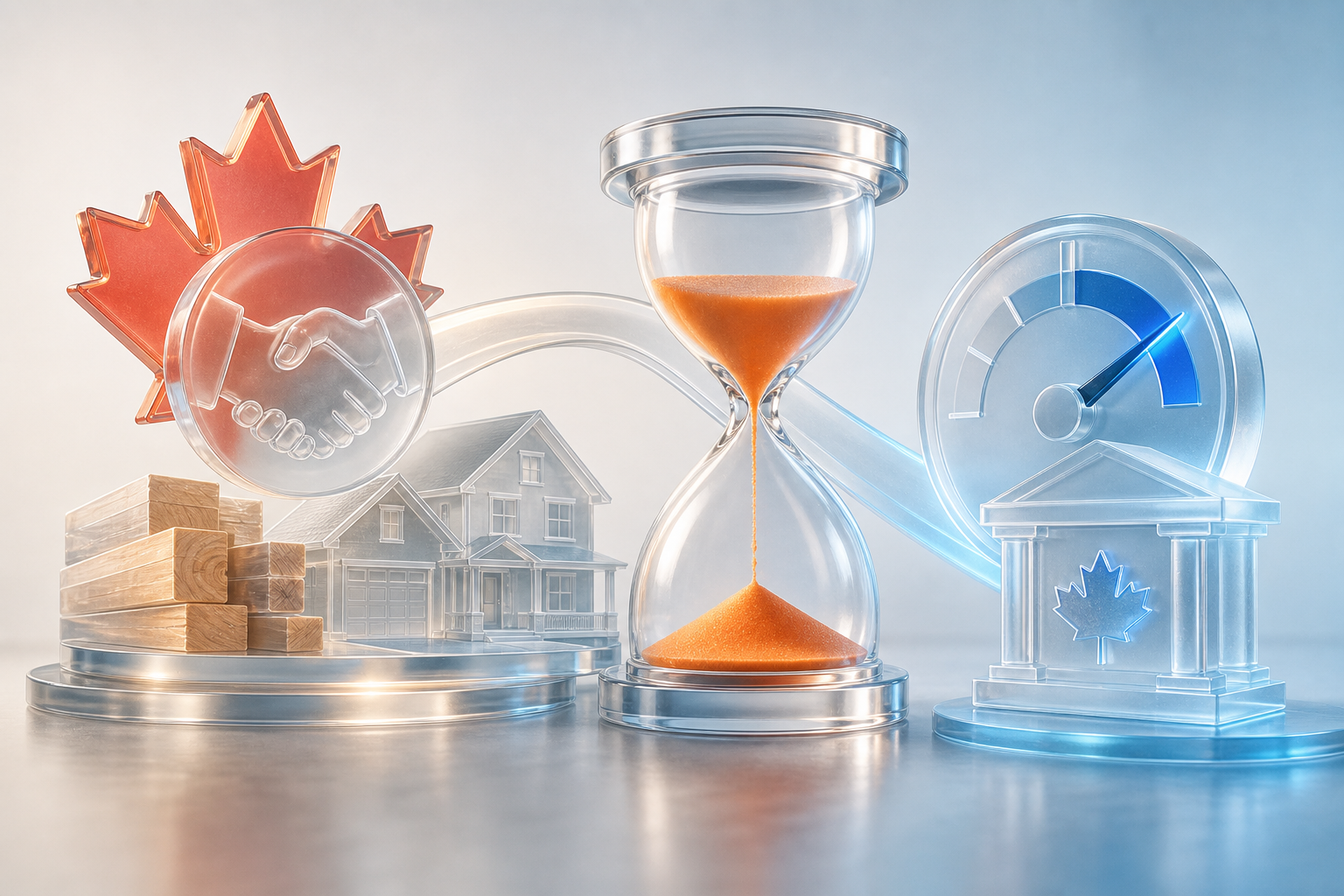

The Bank of Canada cut its overnight rate by 0.5% in July, and the sales-to-new-listings ratio barely moved. Toronto condo inventory sat at 33 days on market in mid-August because nobody is listing. The housing market isn't frozen by cost alone. It's frozen by uncertainty, and a finalized trade agreement with the United States might be the only thing capable of thawing it before 2027.
Canada ships roughly $3.6 billion in goods across the border daily. When that flow is stable, developers can forecast the cost of lumber, steel, appliances, and subflooring with enough confidence to break ground. When it isn't, they sit on zoned land and wait. The CUSMA review in 2026 turned what should have been routine into a negotiating window, and the construction industry responded the way it always does to policy risk: by not building.
Why Lumber Costs More Than You Think
Softwood lumber duties have historically bounced between 8% and 15%, depending on which round of the trade war we're in. A 10% swing on framing lumber for a 2,200-square-foot detached build in suburban Mississauga adds roughly $4,000 to $6,000 in material costs before the general contractor's markup. That's manageable in a hot market where buyers stretch. It's a deal-killer in a market where the average household is carrying a debt-to-disposable-income ratio near 175% and has no room for a surprise $8,000 floor-price bump.
A stable trade deal removes the variance. Developers can lock a bid and know the number will hold for 18 months. They need that certainty to break ground on a new site.
The Paradox Nobody's Talking About
Here's the structural problem: if a trade deal works the way it's supposed to, it boosts cross-border investment, stabilizes employment in export-heavy sectors, and gives the overall economy a confidence jolt. That jolt is inflationary. The Bank of Canada, which spent 2022 and 2023 hiking rates to kill inflation, would have no choice but to hold rates higher for longer, or even reverse course if GDP growth accelerates too quickly.
The housing market doesn't benefit from a trade deal in that scenario. It gets crushed by it.
The people who refinanced fixed-rate mortgages in 2021 at 1.79% are starting to renew now at rates above 5%. A household in Etobicoke carrying a $650,000 mortgage that was costing $2,400 a month is now looking at $3,600. Add another 0.25% because trade-driven inflation forced the Bank to pause cuts, and that's another $85 a month. Multiply that across two million renewal households between now and 2028, and you have a consumer spending contraction regardless of what the trade deal does for business confidence.
The Buyer Who Isn't There Yet
The sidelined buyer, the one with 15% down, stable income, and a pre-approval sitting in a drawer, is not waiting for a better interest rate. Rates have come down. They're waiting for a reason to believe the next 24 months won't be worse than the last 24. A signed trade deal, particularly one that removes the threat of retaliatory tariffs on Canadian exports, gives that buyer permission to move.
The developer already has the land. The buyer already has the income. What neither of them has is certainty that the macro environment won't collapse the deal halfway through. Trade policy doesn't create housing demand, but it does release the demand that's already there and waiting for a signal.
The problem is timing. Trade negotiations take months to filter into construction starts, and construction starts take 18 months to become occupied units. If the Bank of Canada hikes rates in response to trade-driven growth before those units hit the market, the whole cycle stalls again. The deal buys time. It doesn't guarantee the time gets used well.
Read Next
Asset managers cut product portfolios to fund AI and outsourcing overhauls
ETFs now hold 42% of Canadian fund assets as OSC tightens crypto and liquidity rules
One in Five Canadian Parents Still Pays Bills for Kids in Their Late Thirties
Joint mortgages surge in Ontario and B.C. as first-time buyers face rising delinquency pressure