Trump's Tariff Threat Could Force Bank of Canada to Cut Rates Against Current Consensus
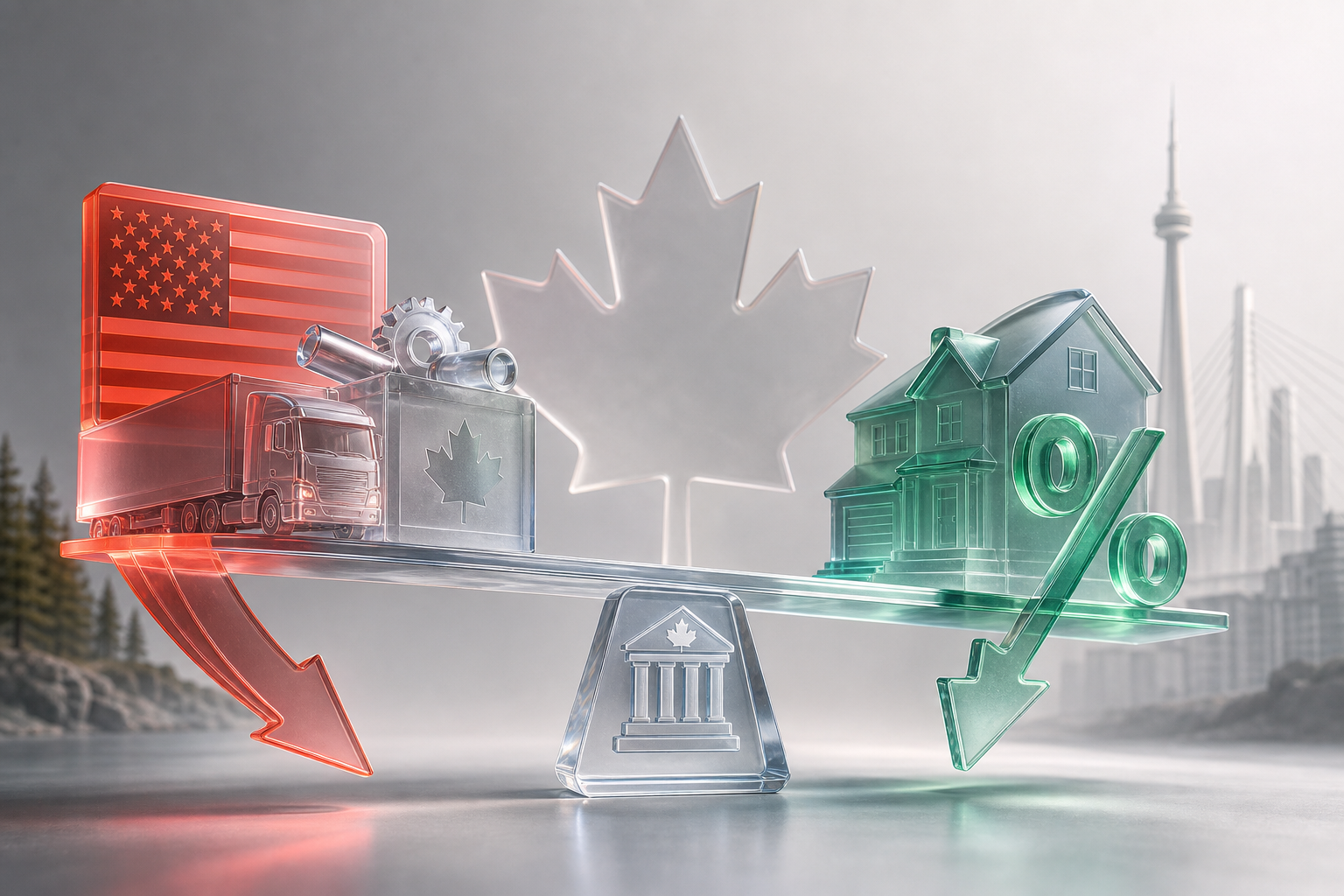
BMO Capital Markets has identified the precise scenario in which the Bank of Canada's 2026 holding pattern could collapse: sustained protectionist measures from a U.S. administration that treats tariffs as negotiating leverage rather than temporary signals.
The bank's baseline assumption had priced in a prolonged pause by the BoC this year. Inflation, particularly in services, had settled into a range that justified neither stimulus nor additional tightening. That equilibrium depends on trade remaining stable. If Washington imposes universal baseline tariffs or sector-specific duties on steel, aluminum, and automotive parts, sectors that together account for roughly $100 billion in annual Canadian exports, the BoC faces a choice between two bad outcomes.
The Growth Shock Outweighs the Price Shock
Tariffs push in opposite directions. They make imported goods more expensive, showing up as inflation. They also destroy demand, as exporters lose access to their largest market and pull back on investment and hiring. BMO's argument is that the second effect dominates.
Canada sends 75% of its goods exports to the U.S., according to Statistics Canada's 2026 trade data. A 10% tariff on Canadian manufactured goods does not cut export volumes by 10%. It cuts them by more, because U.S. buyers switch to domestic suppliers or third countries exempt from the tariff. The revenue hit compounds as firms delay capital projects and shed workers in export-dependent regions.
Central banks typically "look through" one-time price increases caused by taxes or tariffs. The BoC's mandate is to stabilize inflation over the medium term, not to fight every temporary spike. If tariffs raise the cost of imported steel by 15% but trigger a recession that drops core inflation below 1%, the BoC's job is to cut rates and prevent the downturn from feeding on itself.
This creates the unusual condition in which bad news for Canada's export economy becomes mechanically good news for anyone carrying variable-rate debt. A trade war that shaves half a point off GDP growth in 2027 would almost certainly force the BoC to ease even if headline inflation remains above 2% temporarily.
Why the Consensus Could Be Wrong
The market's current posture assumes steady conditions. Bond yields, which set fixed mortgage rates, have priced in stability through late 2026. That pricing breaks if cross-border trade friction escalates during the USMCA review scheduled for mid-2026, creating uncertainty that weighs on business investment long before any tariffs formally take effect.
The deeper risk is policy divergence. If the U.S. Federal Reserve holds rates steady to manage domestic inflation while the BoC cuts to offset a trade-driven slowdown, the spread between Canadian and U.S. rates widens. A weaker Canadian dollar follows. That makes imports more expensive across the board, layering imported inflation on top of the growth shock tariffs already caused.
At that point, the BoC is trapped. Cutting rates might not stimulate enough domestic demand to offset lost exports, while a collapsing Loonie keeps inflation uncomfortably high. The bank would be forced to choose the lesser damage: accept above-target inflation temporarily, or let unemployment rise sharply.
BMO's framing is careful. The bank is not predicting cuts. It is identifying the condition under which cuts become unavoidable. The difference matters. Policy depends on what Washington does, not what the Canadian economy wants.
For mortgage holders, this creates asymmetric exposure. Fixed-rate borrowers locked in at 4.5% or higher during the BoC's tightening cycle remain insulated. Variable-rate holders benefit immediately if the overnight rate drops, but only if the trade shock that forced the cut doesn't also cost them their job.


BMO Capital Markets has identified the precise scenario in which the Bank of Canada's 2026 holding pattern could collapse: sustained protectionist measures from a U.S. administration that treats tariffs as negotiating leverage rather than temporary signals.
The bank's baseline assumption had priced in a prolonged pause by the BoC this year. Inflation, particularly in services, had settled into a range that justified neither stimulus nor additional tightening. That equilibrium depends on trade remaining stable. If Washington imposes universal baseline tariffs or sector-specific duties on steel, aluminum, and automotive parts, sectors that together account for roughly $100 billion in annual Canadian exports, the BoC faces a choice between two bad outcomes.
The Growth Shock Outweighs the Price Shock
Tariffs push in opposite directions. They make imported goods more expensive, showing up as inflation. They also destroy demand, as exporters lose access to their largest market and pull back on investment and hiring. BMO's argument is that the second effect dominates.
Canada sends 75% of its goods exports to the U.S., according to Statistics Canada's 2026 trade data. A 10% tariff on Canadian manufactured goods does not cut export volumes by 10%. It cuts them by more, because U.S. buyers switch to domestic suppliers or third countries exempt from the tariff. The revenue hit compounds as firms delay capital projects and shed workers in export-dependent regions.
Central banks typically "look through" one-time price increases caused by taxes or tariffs. The BoC's mandate is to stabilize inflation over the medium term, not to fight every temporary spike. If tariffs raise the cost of imported steel by 15% but trigger a recession that drops core inflation below 1%, the BoC's job is to cut rates and prevent the downturn from feeding on itself.
This creates the unusual condition in which bad news for Canada's export economy becomes mechanically good news for anyone carrying variable-rate debt. A trade war that shaves half a point off GDP growth in 2027 would almost certainly force the BoC to ease even if headline inflation remains above 2% temporarily.
Why the Consensus Could Be Wrong
The market's current posture assumes steady conditions. Bond yields, which set fixed mortgage rates, have priced in stability through late 2026. That pricing breaks if cross-border trade friction escalates during the USMCA review scheduled for mid-2026, creating uncertainty that weighs on business investment long before any tariffs formally take effect.
The deeper risk is policy divergence. If the U.S. Federal Reserve holds rates steady to manage domestic inflation while the BoC cuts to offset a trade-driven slowdown, the spread between Canadian and U.S. rates widens. A weaker Canadian dollar follows. That makes imports more expensive across the board, layering imported inflation on top of the growth shock tariffs already caused.
At that point, the BoC is trapped. Cutting rates might not stimulate enough domestic demand to offset lost exports, while a collapsing Loonie keeps inflation uncomfortably high. The bank would be forced to choose the lesser damage: accept above-target inflation temporarily, or let unemployment rise sharply.
BMO's framing is careful. The bank is not predicting cuts. It is identifying the condition under which cuts become unavoidable. The difference matters. Policy depends on what Washington does, not what the Canadian economy wants.
For mortgage holders, this creates asymmetric exposure. Fixed-rate borrowers locked in at 4.5% or higher during the BoC's tightening cycle remain insulated. Variable-rate holders benefit immediately if the overnight rate drops, but only if the trade shock that forced the cut doesn't also cost them their job.
Read Next
Asset managers cut product portfolios to fund AI and outsourcing overhauls
ETFs now hold 42% of Canadian fund assets as OSC tightens crypto and liquidity rules
One in Five Canadian Parents Still Pays Bills for Kids in Their Late Thirties
Joint mortgages surge in Ontario and B.C. as first-time buyers face rising delinquency pressure