Why $150 Student Tenant Insurance Could Save You $2,000 This School Year
Your landlord texts at 2 AM: the unit above yours flooded, and water destroyed everything in your closet and desk area. Your laptop, textbooks, and winter coat are ruined. The building is uninhabitable for two weeks. You're now facing a $2,500 replacement bill, plus hotel costs, with no refund on this month's rent.
Most students skip tenant insurance because the $15-to-$30 monthly premium feels like one more bill they can't afford. The math works the other way. A year of coverage costs roughly $300. A single laptop-and-phone replacement runs $2,500. A liability claim if you cause building damage can hit $50,000.
What the policy actually covers
Tenant insurance in Canada has three parts. Personal property covers your belongings, laptop, phone, furniture, clothes, textbooks, whether they're stolen or damaged by fire, water, or vandalism. Liability covers legal responsibility if you accidentally damage the building or injure someone in your unit. Additional living expenses (ALE) pays for temporary housing and meals if your rental becomes unlivable due to a covered event.
The property portion pays replacement cost, not depreciated value. A two-year-old laptop gets replaced with a new one, not reimbursed at used-item prices. Most policies also cover belongings off-site, meaning your phone is protected if stolen from the library or during travel.
Liability is the part students underestimate. If you leave a pot on the stove and start a kitchen fire, your landlord can sue you for building repairs. Ontario and BC landlords now commonly require $1 million in liability coverage as a lease condition. $2 million is becoming standard in Toronto and Vancouver. Without a policy, you're personally on the hook.
The parent-policy loophole
Before buying coverage, call your parents' home insurance provider. If you're still listed as a dependent and living away only for school, many policies extend coverage at no extra cost. The limits are usually lower, $5,000 to $10,000 in personal property instead of the full amount, but it's free. If your belongings are worth less than the extended coverage cap, you don't need a separate policy.
This loophole closes the moment you're no longer a dependent, graduate, or sign a year-round lease unrelated to school. It also doesn't cover roommates. Each tenant needs their own policy unless specifically named together, which most providers don't allow.
Where the $2,000 figure comes from
A mid-range student laptop costs $1,200. A phone runs $800 to $1,000. Add a winter coat, bedding, a few kitchen appliances, and textbooks, and you're past $2,500 in personal property before counting furniture. The deductible on most policies is $500, meaning you pay the first $500 of any claim. If everything is destroyed, the insurer covers the remaining $2,000-plus.
The ALE portion is what saves students during displacement events. If a flood or fire makes the unit unlivable, the policy pays for a hotel and meals until you can return or find alternate housing. A two-week hotel stay in a university town easily runs $1,400. ALE covers it.
The scenarios insurance doesn't cover
Standard policies exclude "mysterious disappearance," meaning if you lose your phone at a bar or can't remember where you left your backpack, there's no claim. Damage caused by your pet isn't covered unless you add a rider. If you sublet your room for the summer without notifying the insurer, the policy is void during that period.
The $500 deductible also means theft of a single low-value item isn't worth claiming. If someone steals your $400 bike, you pay $400 out-of-pocket anyway. The policy's value is in catastrophic loss, fire, flood, or theft of everything at once, and in liability protection.
Most landlords in tight rental markets now make insurance mandatory. At $150 per semester, the policy costs less than a month of groceries and closes a gap that can otherwise cost you a semester's savings in a single bad night.

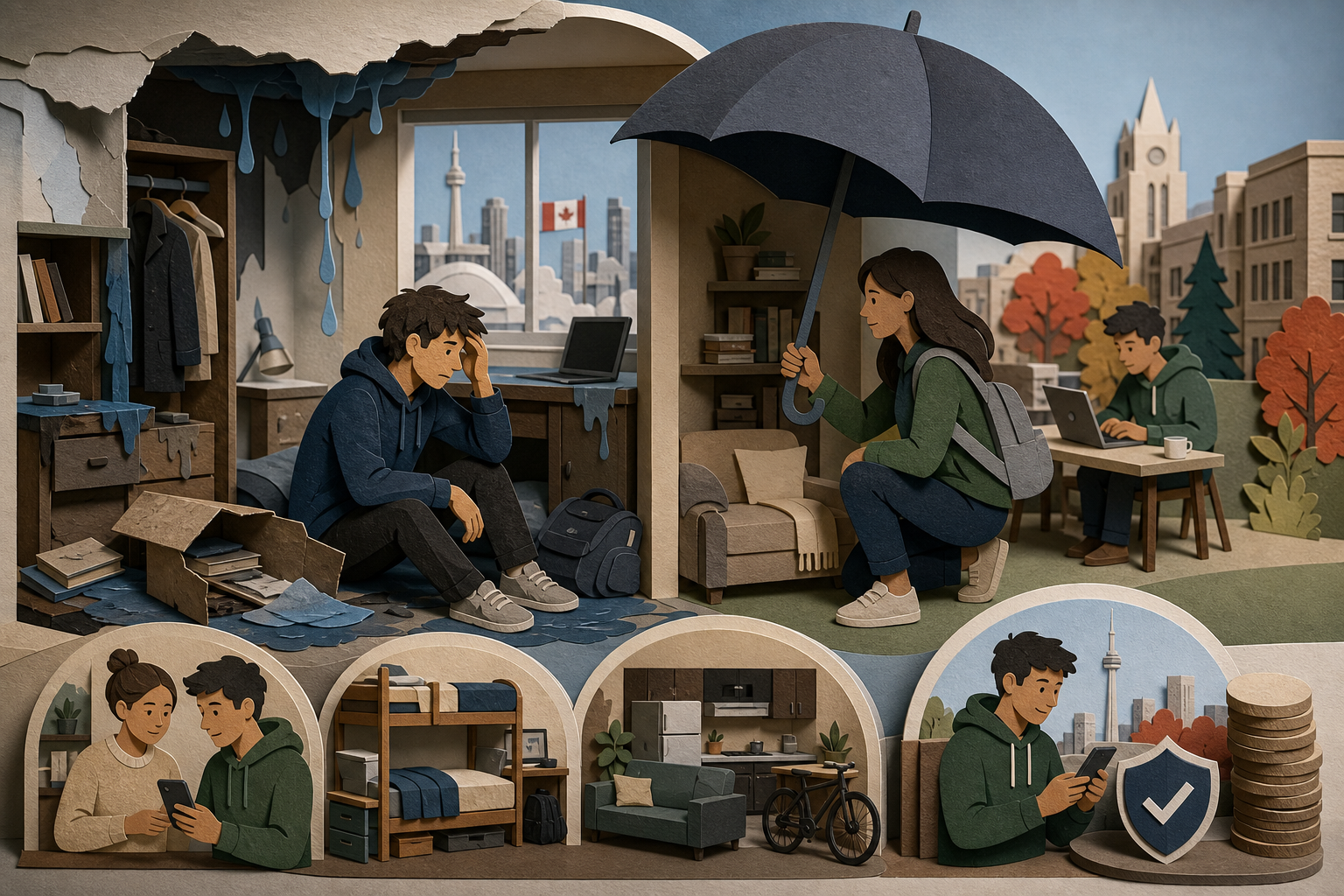

Your landlord texts at 2 AM: the unit above yours flooded, and water destroyed everything in your closet and desk area. Your laptop, textbooks, and winter coat are ruined. The building is uninhabitable for two weeks. You're now facing a $2,500 replacement bill, plus hotel costs, with no refund on this month's rent.
Most students skip tenant insurance because the $15-to-$30 monthly premium feels like one more bill they can't afford. The math works the other way. A year of coverage costs roughly $300. A single laptop-and-phone replacement runs $2,500. A liability claim if you cause building damage can hit $50,000.
What the policy actually covers
Tenant insurance in Canada has three parts. Personal property covers your belongings, laptop, phone, furniture, clothes, textbooks, whether they're stolen or damaged by fire, water, or vandalism. Liability covers legal responsibility if you accidentally damage the building or injure someone in your unit. Additional living expenses (ALE) pays for temporary housing and meals if your rental becomes unlivable due to a covered event.
The property portion pays replacement cost, not depreciated value. A two-year-old laptop gets replaced with a new one, not reimbursed at used-item prices. Most policies also cover belongings off-site, meaning your phone is protected if stolen from the library or during travel.
Liability is the part students underestimate. If you leave a pot on the stove and start a kitchen fire, your landlord can sue you for building repairs. Ontario and BC landlords now commonly require $1 million in liability coverage as a lease condition. $2 million is becoming standard in Toronto and Vancouver. Without a policy, you're personally on the hook.
The parent-policy loophole
Before buying coverage, call your parents' home insurance provider. If you're still listed as a dependent and living away only for school, many policies extend coverage at no extra cost. The limits are usually lower, $5,000 to $10,000 in personal property instead of the full amount, but it's free. If your belongings are worth less than the extended coverage cap, you don't need a separate policy.
This loophole closes the moment you're no longer a dependent, graduate, or sign a year-round lease unrelated to school. It also doesn't cover roommates. Each tenant needs their own policy unless specifically named together, which most providers don't allow.
Where the $2,000 figure comes from
A mid-range student laptop costs $1,200. A phone runs $800 to $1,000. Add a winter coat, bedding, a few kitchen appliances, and textbooks, and you're past $2,500 in personal property before counting furniture. The deductible on most policies is $500, meaning you pay the first $500 of any claim. If everything is destroyed, the insurer covers the remaining $2,000-plus.
The ALE portion is what saves students during displacement events. If a flood or fire makes the unit unlivable, the policy pays for a hotel and meals until you can return or find alternate housing. A two-week hotel stay in a university town easily runs $1,400. ALE covers it.
The scenarios insurance doesn't cover
Standard policies exclude "mysterious disappearance," meaning if you lose your phone at a bar or can't remember where you left your backpack, there's no claim. Damage caused by your pet isn't covered unless you add a rider. If you sublet your room for the summer without notifying the insurer, the policy is void during that period.
The $500 deductible also means theft of a single low-value item isn't worth claiming. If someone steals your $400 bike, you pay $400 out-of-pocket anyway. The policy's value is in catastrophic loss, fire, flood, or theft of everything at once, and in liability protection.
Most landlords in tight rental markets now make insurance mandatory. At $150 per semester, the policy costs less than a month of groceries and closes a gap that can otherwise cost you a semester's savings in a single bad night.
Read Next
Asset managers cut product portfolios to fund AI and outsourcing overhauls
ETFs now hold 42% of Canadian fund assets as OSC tightens crypto and liquidity rules
One in Five Canadian Parents Still Pays Bills for Kids in Their Late Thirties
Joint mortgages surge in Ontario and B.C. as first-time buyers face rising delinquency pressure