Why a 50% Tariff Just Killed Your Rental Property Renovation Economics
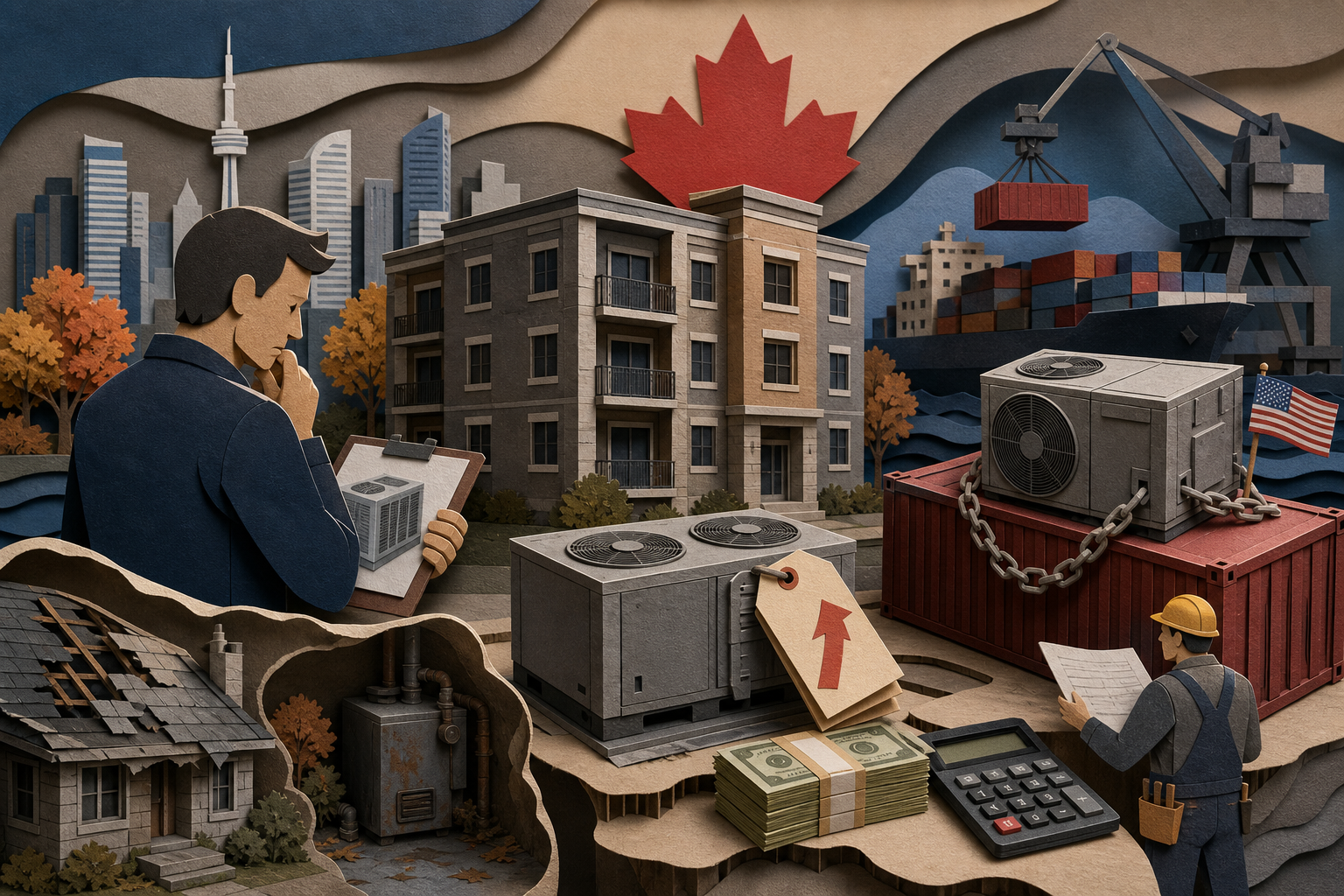
A four-unit building in Mississauga needs a new HVAC system. The contractor quotes $68,000 for the job. The owner runs the numbers: at a 6.5% mortgage rate, the monthly payment on that amount is $430, which gets recovered through an Above Guideline Increase filing with the Landlord and Tenant Board. The project clears the hurdle rate by two percentage points. Then the tariff hits.
As of August 22, 2026, the U.S. applied a 50% tariff on $27.6 billion worth of Canadian imports, targeting steel, aluminum, and finished manufacturing goods, the exact materials rental property owners use for large-scale renovations. That $68,000 HVAC system, if the components are U.S.-sourced, is now $102,000. The monthly financing cost jumps to $645. The project that cleared the hurdle rate now destroys capital.
The Yield Spread Collapses
Rental property returns depend on the spread between the capitalization rate and the cost of capital. If a renovation's internal rate of return drops below what you're paying to borrow, the project is mathematically a bad trade. A 50% increase in a major line item doesn't just trim margin. It flips the sign.
Most small-to-mid-sized investors operate on thin margins. A 10% total project cost increase is often the tipping point that leads to indefinite postponement. A 50% increase on a core component, structural steel for a deck addition, commercial-grade HVAC, or load-bearing beams, can push total project costs up 15% to 25%, depending on the renovation's scope.
In Ontario, where rent increase guidelines are capped at 2.1% annually for 2026, landlords can't simply "price in" the tariff by raising rent across the board. An Above Guideline Increase requires Landlord and Tenant Board approval and detailed capital expenditure documentation. If the adjudicator determines the cost became "unreasonable" due to tariffs, the AGI can be denied. The renovation becomes a zombie project: started, but unable to be completed profitably.
The Shadow Costs Compound
The 50% tariff is not a 50% total cost increase. It's the opening bid. The ripple includes higher HST on the larger invoice, increased financing costs on the bigger loan, and contractor contingency fees that rise when material costs become volatile. A renovation that was 60% materials and 40% labour sees materials jump, which pushes the HST base higher, which increases the amount financed, which increases the interest paid over the loan's life.
A concrete example: a $50,000 renovation at 13% HST costs $56,500 all-in. At 6.5% over 10 years, total interest paid is $12,300. If the materials component ($30,000) rises by 50% due to tariffs, the new base is $65,000. With HST, that's $73,450. Total interest over 10 years: $16,000. The tariff added $16,950 to the headline cost and an extra $3,700 in financing costs. The real damage is $20,650, not the $15,000 most investors pencil in at first glance.
The Replacement Cycle Trap
High-net-worth investors often defer maintenance during trade volatility, assuming they'll restart work when prices normalize. This creates maintenance debt. A boiler deferred in 2026 fails catastrophically in 2028, when parts are even scarcer and contractors are booked six months out. The cost of emergency replacement typically runs 30% to 50% higher than planned replacement.
The threshold effect is sharp. Properties that were one major capital project away from achieving a target after-repair value now sit in limbo. The valuation compression is immediate: if comparable properties in the neighbourhood are trading at $850,000 and your building needs $120,000 in deferred capital work to reach that valuation, but the cost is now $180,000 due to tariffs, your effective property value drops by the difference. The market reprices the asset based on the cost to cure, not the cost you originally budgeted.
Canada remains one of the largest importers of U.S.-fabricated steel and HVAC components used in multi-family renovations. The counter-tariffs implemented by Canada on September 8, 2026, specifically target finished steel products, the same materials property owners need. Both directions of trade are now friction-heavy.
Investors sourcing domestically or through CETA partners face longer lead times but bypass the tariff. The math becomes a question of whether a four-month delay and a 15% cost increase beats a 50% tariff with immediate availability. Most projects sit while owners run the numbers.


A four-unit building in Mississauga needs a new HVAC system. The contractor quotes $68,000 for the job. The owner runs the numbers: at a 6.5% mortgage rate, the monthly payment on that amount is $430, which gets recovered through an Above Guideline Increase filing with the Landlord and Tenant Board. The project clears the hurdle rate by two percentage points. Then the tariff hits.
As of August 22, 2026, the U.S. applied a 50% tariff on $27.6 billion worth of Canadian imports, targeting steel, aluminum, and finished manufacturing goods, the exact materials rental property owners use for large-scale renovations. That $68,000 HVAC system, if the components are U.S.-sourced, is now $102,000. The monthly financing cost jumps to $645. The project that cleared the hurdle rate now destroys capital.
The Yield Spread Collapses
Rental property returns depend on the spread between the capitalization rate and the cost of capital. If a renovation's internal rate of return drops below what you're paying to borrow, the project is mathematically a bad trade. A 50% increase in a major line item doesn't just trim margin. It flips the sign.
Most small-to-mid-sized investors operate on thin margins. A 10% total project cost increase is often the tipping point that leads to indefinite postponement. A 50% increase on a core component, structural steel for a deck addition, commercial-grade HVAC, or load-bearing beams, can push total project costs up 15% to 25%, depending on the renovation's scope.
In Ontario, where rent increase guidelines are capped at 2.1% annually for 2026, landlords can't simply "price in" the tariff by raising rent across the board. An Above Guideline Increase requires Landlord and Tenant Board approval and detailed capital expenditure documentation. If the adjudicator determines the cost became "unreasonable" due to tariffs, the AGI can be denied. The renovation becomes a zombie project: started, but unable to be completed profitably.
The Shadow Costs Compound
The 50% tariff is not a 50% total cost increase. It's the opening bid. The ripple includes higher HST on the larger invoice, increased financing costs on the bigger loan, and contractor contingency fees that rise when material costs become volatile. A renovation that was 60% materials and 40% labour sees materials jump, which pushes the HST base higher, which increases the amount financed, which increases the interest paid over the loan's life.
A concrete example: a $50,000 renovation at 13% HST costs $56,500 all-in. At 6.5% over 10 years, total interest paid is $12,300. If the materials component ($30,000) rises by 50% due to tariffs, the new base is $65,000. With HST, that's $73,450. Total interest over 10 years: $16,000. The tariff added $16,950 to the headline cost and an extra $3,700 in financing costs. The real damage is $20,650, not the $15,000 most investors pencil in at first glance.
The Replacement Cycle Trap
High-net-worth investors often defer maintenance during trade volatility, assuming they'll restart work when prices normalize. This creates maintenance debt. A boiler deferred in 2026 fails catastrophically in 2028, when parts are even scarcer and contractors are booked six months out. The cost of emergency replacement typically runs 30% to 50% higher than planned replacement.
The threshold effect is sharp. Properties that were one major capital project away from achieving a target after-repair value now sit in limbo. The valuation compression is immediate: if comparable properties in the neighbourhood are trading at $850,000 and your building needs $120,000 in deferred capital work to reach that valuation, but the cost is now $180,000 due to tariffs, your effective property value drops by the difference. The market reprices the asset based on the cost to cure, not the cost you originally budgeted.
Canada remains one of the largest importers of U.S.-fabricated steel and HVAC components used in multi-family renovations. The counter-tariffs implemented by Canada on September 8, 2026, specifically target finished steel products, the same materials property owners need. Both directions of trade are now friction-heavy.
Investors sourcing domestically or through CETA partners face longer lead times but bypass the tariff. The math becomes a question of whether a four-month delay and a 15% cost increase beats a 50% tariff with immediate availability. Most projects sit while owners run the numbers.
Sources
Read Next
Asset managers cut product portfolios to fund AI and outsourcing overhauls
ETFs now hold 42% of Canadian fund assets as OSC tightens crypto and liquidity rules
One in Five Canadian Parents Still Pays Bills for Kids in Their Late Thirties
Joint mortgages surge in Ontario and B.C. as first-time buyers face rising delinquency pressure