Why Northern Home Prices Rise Even as Sales Move in Opposite Directions
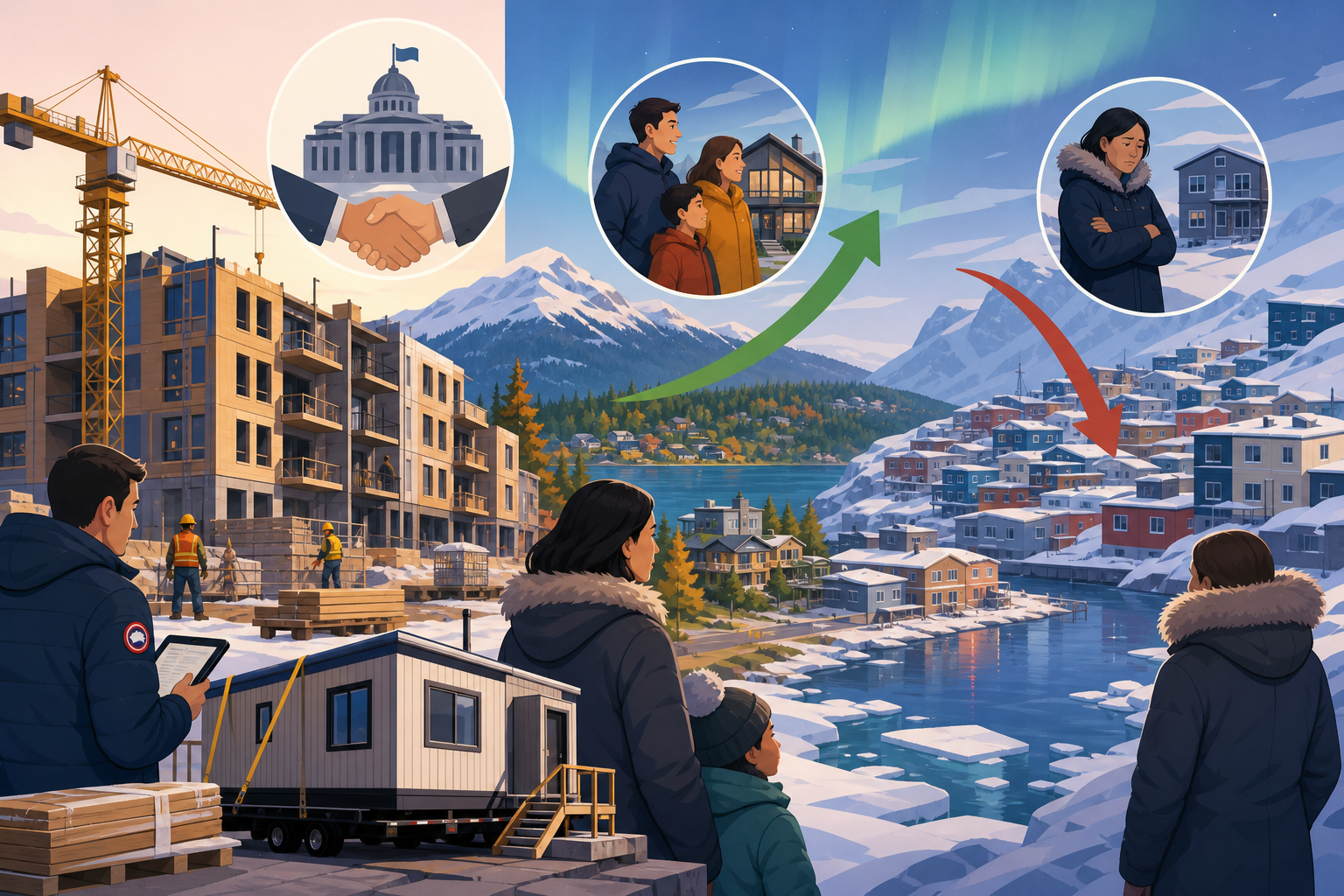
Iqaluit's average single-family home now costs more than $1 million. Transaction volume this year fell another 15 percent. Both facts are true at the same time, and that combination tells you more about how housing markets actually function than years of southern market data ever could.
In Whitehorse and Yellowknife, sales rebounded sharply in the first half of 2026 following years of stagnation. Whitehorse saw double-digit percentage increases in closed transactions compared to 2025. Yellowknife returned to pre-2023 wildfire levels after months of buyer hesitation. Yet in Iqaluit, sales continued their decline. Fewer listings. Fewer closings. Prices still climbing.
The conventional understanding treats price and volume as linked. When demand weakens, prices fall. When sales pick up, prices rise. Northern markets break that link because they operate under a constraint southern markets rarely face: physical inability to respond to demand with supply.
The construction problem isn't financial
Building in the territories costs roughly double what it costs in southern Canada. Labor must be flown in. Materials arrive by sealift once a year or by air at severe markup. The construction season runs four to five months, not eight. Permafrost adds engineering complexity and foundation costs that have no equivalent in temperate zones.
Those costs do not fluctuate with interest rates. A rate cut from the Bank of Canada does not make it cheaper to pour footings into frozen ground or extend the shipping window. The result is a supply curve that is nearly vertical: build costs are so high and logistical barriers so rigid that price signals barely move the quantity of new construction. Builders do not flood the market when prices rise because flooding the market is not possible.
In Iqaluit, this creates a market that has effectively stopped circulating. Current owners cannot move up because there are no move-up properties. Entry-level buyers cannot get in because entry-level owners are not selling. The few transactions that do occur set the price benchmark, and because those transactions involve the best available inventory in a pool of almost nothing, the benchmark stays elevated or rises. Low sales and high prices become mutually reinforcing rather than contradictory.
Government crowds out the middle
A large share of territorial housing stock is employer-provided, primarily by the Government of Nunavut, Yukon Territorial Government, and Northwest Territories government. These units house civil servants and are not available to private buyers. The effect is to shrink the addressable private market while simultaneously anchoring a significant portion of the population, people with stable incomes and housing security, who would otherwise be competing for resale inventory.
In Whitehorse and Yellowknife, where the private market is larger and government's share is proportionally smaller, this distortion is less severe. Sales recovered because there was enough of a functioning resale market to recover into. Iqaluit has no such cushion. The private inventory is so constrained that a 15 percent drop in sales is not a slowdown. It is closer to market failure for anyone not already inside.
Prices in all three capitals continued upward through 2026 not because buyers are exuberant but because the alternative to paying the asking price is not finding another option. Vacancy rates across the territories remain among the lowest in Canada. Rental supply is similarly tight. The question facing most households is not "should I pay this much?" but "where else would I live?"
The Whitehorse and Yellowknife rebounds suggest that when supply constraints ease even slightly, when a few more listings appear, when construction manages to add a handful of units, the latent demand converts immediately into transactions. Iqaluit's decline suggests what happens when supply constraints do not ease. The market becomes a market in name only. Prices reflect scarcity, not equilibrium.


Iqaluit's average single-family home now costs more than $1 million. Transaction volume this year fell another 15 percent. Both facts are true at the same time, and that combination tells you more about how housing markets actually function than years of southern market data ever could.
In Whitehorse and Yellowknife, sales rebounded sharply in the first half of 2026 following years of stagnation. Whitehorse saw double-digit percentage increases in closed transactions compared to 2025. Yellowknife returned to pre-2023 wildfire levels after months of buyer hesitation. Yet in Iqaluit, sales continued their decline. Fewer listings. Fewer closings. Prices still climbing.
The conventional understanding treats price and volume as linked. When demand weakens, prices fall. When sales pick up, prices rise. Northern markets break that link because they operate under a constraint southern markets rarely face: physical inability to respond to demand with supply.
The construction problem isn't financial
Building in the territories costs roughly double what it costs in southern Canada. Labor must be flown in. Materials arrive by sealift once a year or by air at severe markup. The construction season runs four to five months, not eight. Permafrost adds engineering complexity and foundation costs that have no equivalent in temperate zones.
Those costs do not fluctuate with interest rates. A rate cut from the Bank of Canada does not make it cheaper to pour footings into frozen ground or extend the shipping window. The result is a supply curve that is nearly vertical: build costs are so high and logistical barriers so rigid that price signals barely move the quantity of new construction. Builders do not flood the market when prices rise because flooding the market is not possible.
In Iqaluit, this creates a market that has effectively stopped circulating. Current owners cannot move up because there are no move-up properties. Entry-level buyers cannot get in because entry-level owners are not selling. The few transactions that do occur set the price benchmark, and because those transactions involve the best available inventory in a pool of almost nothing, the benchmark stays elevated or rises. Low sales and high prices become mutually reinforcing rather than contradictory.
Government crowds out the middle
A large share of territorial housing stock is employer-provided, primarily by the Government of Nunavut, Yukon Territorial Government, and Northwest Territories government. These units house civil servants and are not available to private buyers. The effect is to shrink the addressable private market while simultaneously anchoring a significant portion of the population, people with stable incomes and housing security, who would otherwise be competing for resale inventory.
In Whitehorse and Yellowknife, where the private market is larger and government's share is proportionally smaller, this distortion is less severe. Sales recovered because there was enough of a functioning resale market to recover into. Iqaluit has no such cushion. The private inventory is so constrained that a 15 percent drop in sales is not a slowdown. It is closer to market failure for anyone not already inside.
Prices in all three capitals continued upward through 2026 not because buyers are exuberant but because the alternative to paying the asking price is not finding another option. Vacancy rates across the territories remain among the lowest in Canada. Rental supply is similarly tight. The question facing most households is not "should I pay this much?" but "where else would I live?"
The Whitehorse and Yellowknife rebounds suggest that when supply constraints ease even slightly, when a few more listings appear, when construction manages to add a handful of units, the latent demand converts immediately into transactions. Iqaluit's decline suggests what happens when supply constraints do not ease. The market becomes a market in name only. Prices reflect scarcity, not equilibrium.
Read Next
Asset managers cut product portfolios to fund AI and outsourcing overhauls
ETFs now hold 42% of Canadian fund assets as OSC tightens crypto and liquidity rules
One in Five Canadian Parents Still Pays Bills for Kids in Their Late Thirties
Joint mortgages surge in Ontario and B.C. as first-time buyers face rising delinquency pressure